Cleveland Museum of Art
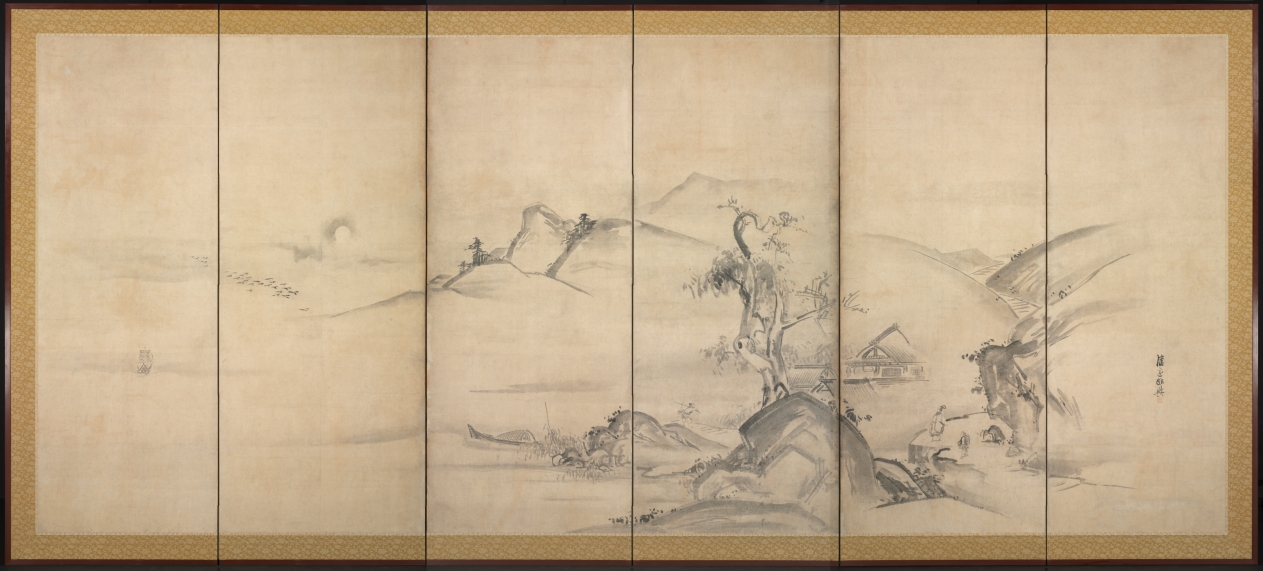
Eight Views of the Xiao and Xiang Rivers
Watanabe ShikōLinkedCulture matchlcp-9cf3749769aa
- Date
- 1700s
- Medium
- Six-panel folding screen, ink on paper
- Culture
- Japan, Edo period (1615–1868)
- Department
- Japanese Art
- Institution
- Cleveland Museum of Art
- Object ID
- 143879
From the Cleveland Museum of Art record
Watanabe Shiko, an Edo period painter who combined Kano school style with Rimpa style, re-created the Xiao and the Xiang rivers on a pair of eight-panel screens. For this composition, he followed the Kano school’s sense of space, adapted from miniature copying paintings ( shukuzu ) by the Japanese artist Kano Tanyu. Watanabe revised the typical representations of the Xiao and the Xiang rivers by rendering the theme Wild Geese Descending to Sandbar on the right screen and Evening Bell from Mist-Shrouded Temple on the left screen. He depicted simple motifs—moon, boat, geese, and temple—to suggest the other scenes while also creating airy space. This screen forms a pair with CMA 1960.284 .
The authoritative record is held by Cleveland Museum of Art. LinkedCulture surfaces this object and its connections; it does not alter institutional metadata.
Get printable QR codesHide QR codes
Open QR codes for this object page and the museum record. They stay collapsed until needed.
Provenance & credit
As published by the source institution. Coverage varies — not every institution's open-data feed includes ownership history.
- Credit line
- Gift of N. V. Hammer
- Provenance
- R. Fukui, Tokyo, Japan | Mayuyama and Co., Tokyo, Japan | ?-1968: N. V. Hammer, New York, NY, given to the Cleveland Museum of Art | 1968-: The Cleveland Museum of Art, Cleveland, OH
Related across collections
Semantically similar works from Cleveland Museum of Art and other institutions.