Cleveland Museum of Art
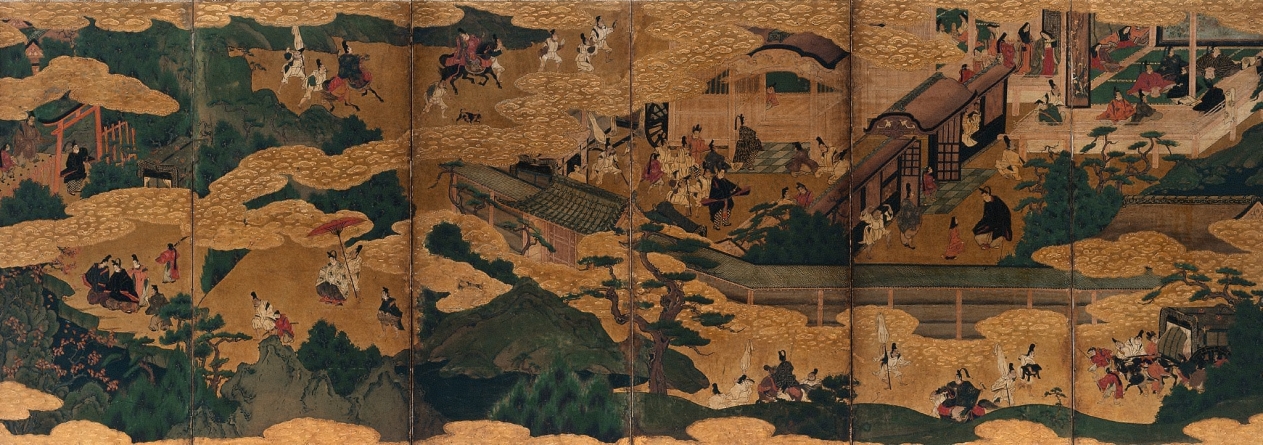
Scenes from the Tales of Ise
- Date
- mid-1600s
- Medium
- One of a pair of six-panel folding screens; ink, color and gold on paper
- Culture
- Japan, Edo period (1615–1868)
- Department
- Japanese Art
- Institution
- Cleveland Museum of Art
- Object ID
- 144293
From the Cleveland Museum of Art record
While the 11th-century Tale of Genji is universally regarded as Japan's literary masterpiece, the source for visual imagery in Japanese culture is rivaled by another literary classic, the Tales of Ise . A 10th-century anthology of poems interspersed with commentary, the Ise portrays the emotional and geographical journey of a courtier from the capital (Kyoto) into the countryside and beyond. The poems describe features of the natural, untamed terrain, linking them to the rather melancholy state of the traveler. Since the Tales of Ise was—and remains today—well read by educated Japanese, a person viewing these folding screens would immediately recognize its subject, organized as a series of discrete scenes read from right to left. Neither a signature nor a seal identifies the artist, but judging from related paintings, the work can be ascribed to an artist working in Kyoto during the first quarter of the 17th century in the manner of the painter Iwasa Matabei (1578–1650). This type of historical narrative composition became quite popular around 1600 among patrons favoring a distinctly Japanese style of painting which employed rich mineral pigments and a liberal use of gold.
The authoritative record is held by Cleveland Museum of Art. LinkedCulture surfaces this object and its connections; it does not alter institutional metadata.
Get printable QR codesHide QR codes
Open QR codes for this object page and the museum record. They stay collapsed until needed.
Provenance & credit
As published by the source institution. Coverage varies — not every institution's open-data feed includes ownership history.
- Credit line
- John L. Severance Fund
- Provenance
- ?-1969: (Elm and Company, Osaka, Japan, sold to the Cleveland Museum of Art) | 1969-: The Cleveland Museum of Art, Cleveland, OH
Related across collections
Semantically similar works from Cleveland Museum of Art and other institutions.