Cleveland Museum of Art
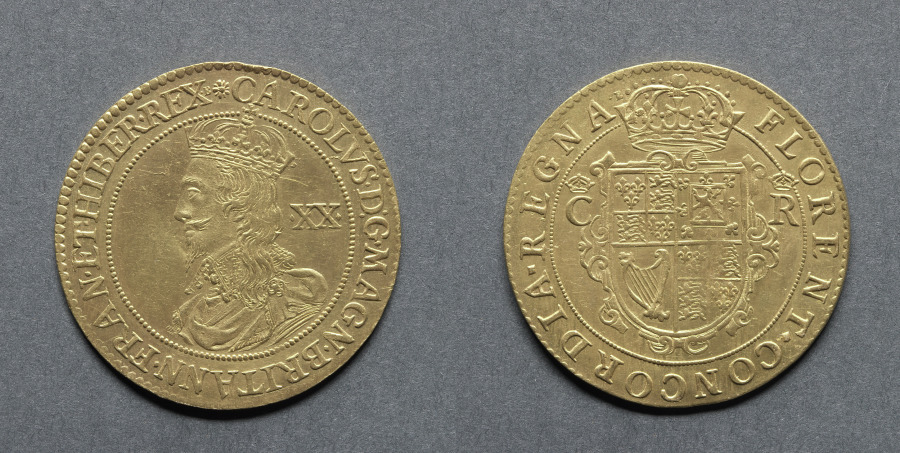
Unite: Charles I (obverse); Crowned Shield (reverse)
Nicholas BriotLinkedCulture matchlcp-a77f4136312f
- Date
- 1631–32
- Medium
- gold
- Culture
- England, Charles I, 1625-1649
- Department
- Medieval Art
- Institution
- Cleveland Museum of Art
- Object ID
- 144476
From the Cleveland Museum of Art record
In 1625 Nicholas Briot traveled from Paris and obtained employment in England. In 1628 he was commissioned to design portraits and in 1631 records show that he was working at the Tower Mint. On his first appointment he was authorized to install machines for striking medals. He was formally empowered on February 11, 1629, to extend their use to experiment on coining. The results were scrutinized in 1631 by a royal commission and the following year he was formally appointment as engraver-general in England and had an augmented salary of 300 pounds. From then until 1638 Briot minted a small fraction of the gold and silver coin by machine. By means of the even pressure of the screw press on a rolled planchet obtained from the rolling mill, and by a collar that kept the metal from flowing unevenly, Briot was able to produce a neat round coin. His fame, however, is that he was the finest die-cutter England had known since Alexander of Brugsal engraved the famous profile portrait of Henry VIII (1485–1509). Like Eloy Mestrelle (1561), Briot met with great opposition from his co-workers, but because of his great artistic ability he was backed by King Charles I and no one could displace him. During the English Civil War he was retained by the Tower, but his influence can be seen in some of the coins struck at Oxford and York, and he also worked in Scotland on some of the Scottish coins. He died in 1646, four years after the war had started. This was the first coin milled or produced by machine in England, previously all issue was hand struck.
The authoritative record is held by Cleveland Museum of Art. LinkedCulture surfaces this object and its connections; it does not alter institutional metadata.
Get printable QR codesHide QR codes
Open QR codes for this object page and the museum record. They stay collapsed until needed.
Provenance & credit
As published by the source institution. Coverage varies — not every institution's open-data feed includes ownership history.
- Credit line
- The Norweb Collection
- Provenance
- -1969: Mrs. Emery May Holden Norweb (1895-1984), Cleveland, OH, gifted to the Cleveland Museum of Art | 1969-: The Cleveland Museum of Art, Cleveland, OH
Related across collections
Semantically similar works from Cleveland Museum of Art and other institutions.