Cleveland Museum of Art
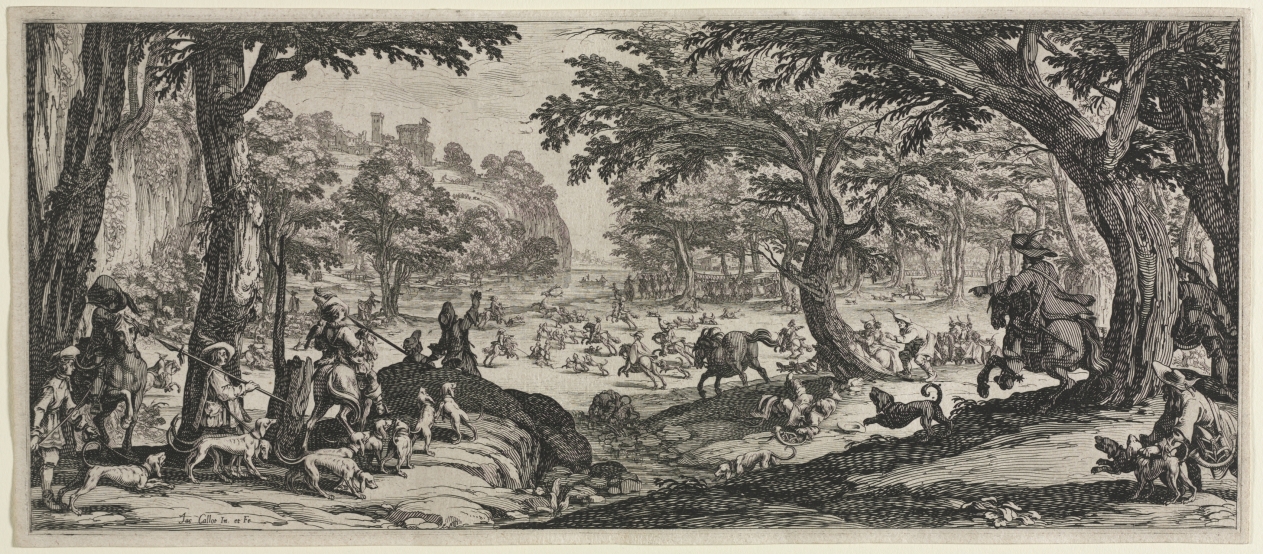
The Large Hunt
Jacques CallotLinkedCulture matchlcp-f057bc8f8cad
- Date
- 1619
- Medium
- etching
- Culture
- France, 17th century
- Department
- Prints
- Institution
- Cleveland Museum of Art
- Object ID
- 145173
What the image shows
A pastoral scene with people and animals in a wooded area.
Generated by LinkedCulture from the photograph alone, without the museum’s catalogue text (Qwen/Qwen2.5-VL-7B-Instruct), and not yet reviewed by a person. It describes the picture, not the object’s history, and it is not part of the museum’s record.
From the Cleveland Museum of Art record
Jacques Callot (French, 1592-1635) The Large Hunt, 1619 Etching Gift of Margaret Crile Garretson in memory of Hiram Garretson 1970.342 Callot is known for two important inventions in etching. He designed a slanted, oval-shaped, steel-tipped etching tool called an échoppe which is used to imitate the tapering and swelling lines of an engraving. He also developed a hard ground (an acid-resistant coating for etching plates), composed of mastic and linseed oil, that resisted chipping. Callot's work was significantly influenced by theater design. His organization of space, usually into three distinct areas (although there are five in this case)-foreground, middleground, and background-resembles stage sets of the time. In fact, this work was probably inspired by a theater screen painted by Federico Zuccaro in 1565. Like Jacques Bellange, whose works are featured in galleries 109 and 110, Callot was from Lorraine. He was one of the most prolific professional printmakers of the 1600s. Trained as an engraver, he worked in Nancy, France, the Low Countries, and in Florence for Grand Duke Cosimo II de' Medici. His range of subjects was broad-religious scenes, theater and pageants, court life, beggars, and landscapes.
The authoritative record is held by Cleveland Museum of Art. LinkedCulture surfaces this object and its connections; it does not alter institutional metadata.
Get printable QR codesHide QR codes
Open QR codes for this object page and the museum record. They stay collapsed until needed.
Provenance & credit
As published by the source institution. Coverage varies — not every institution's open-data feed includes ownership history.
- Credit line
- Gift of Margaret Crile Garretson in memory of Hiram Garretson
- Provenance
- purchased from (P. & D. Colnaghi, NY).
Related across collections
Semantically similar works from Cleveland Museum of Art and other institutions.