Cleveland Museum of Art
Rooster (Gallic Cock)
Raymond Duchamp-VillonLinkedCulture matchlcp-ecbefdde0522
- Date
- 1916 (plaster), cast 1919
- Medium
- painted bronze
- Culture
- France, 20th century
- Department
- Modern European Painting and Sculpture
- Institution
- Cleveland Museum of Art
- Object ID
- 146806
What the image shows
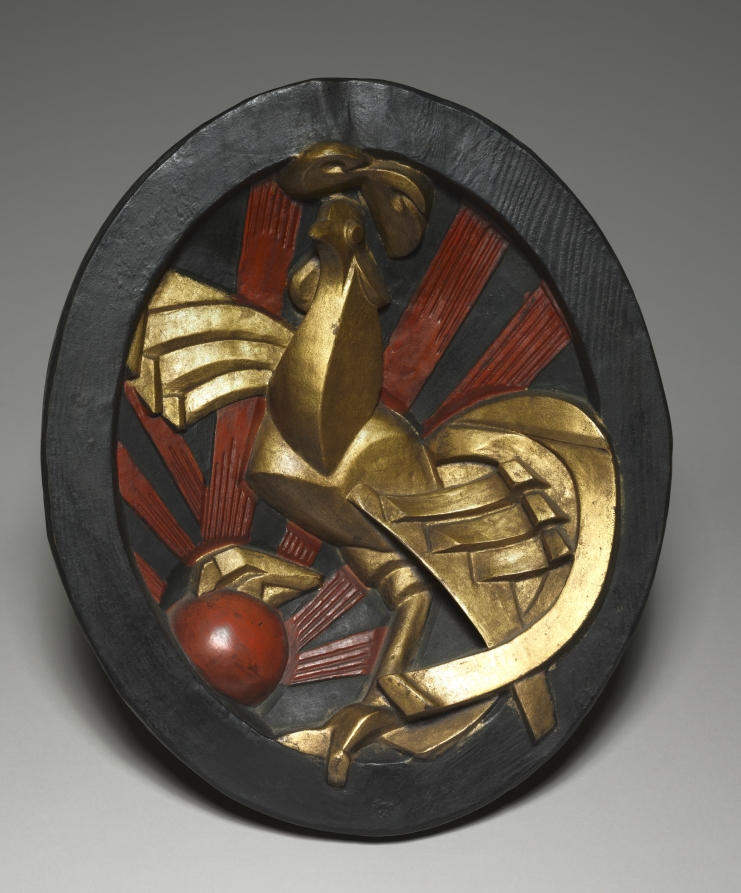
A golden rooster sculpture with red and gold geometric patterns on a black circular background.
Generated by LinkedCulture from the photograph alone, without the museum’s catalogue text (Qwen/Qwen2.5-VL-7B-Instruct), and not yet reviewed by a person. It describes the picture, not the object’s history, and it is not part of the museum’s record.
From the Cleveland Museum of Art record
A pioneer of Cubist sculpture, Duchamp-Villon carved the original plaster for this bronze relief while serving in the army during World War I. It was intended for the entrance to a temporary theater erected near the front lines, where French soldiers would have recognized the rooster and rising sun as symbols of victory. Duchamp-Villon died during the war, and in 1919, five bronze casts were made from his plaster as a memorial to the artist. Before being embraced by artists, the term "Cubism" originated from an insult. The same is true of Gallus, a Latin word meaning both "rooster" and "inhabitant of Gaul" (present-day France). Once used to mock the French, the rooster was reclaimed as a national symbol of triumph, as pictured here.
The authoritative record is held by Cleveland Museum of Art. LinkedCulture surfaces this object and its connections; it does not alter institutional metadata.
Get printable QR codesHide QR codes
Open QR codes for this object page and the museum record. They stay collapsed until needed.
Provenance & credit
As published by the source institution. Coverage varies — not every institution's open-data feed includes ownership history.
- Credit line
- Bequest of Lucia McCurdy McBride
- Provenance
- John Quinn | 1927: Lucia McCurdy McBride | John Quinn; Lucia McCurdy McBride, 1927
Related across collections
Semantically similar works from Cleveland Museum of Art and other institutions.