Cleveland Museum of Art
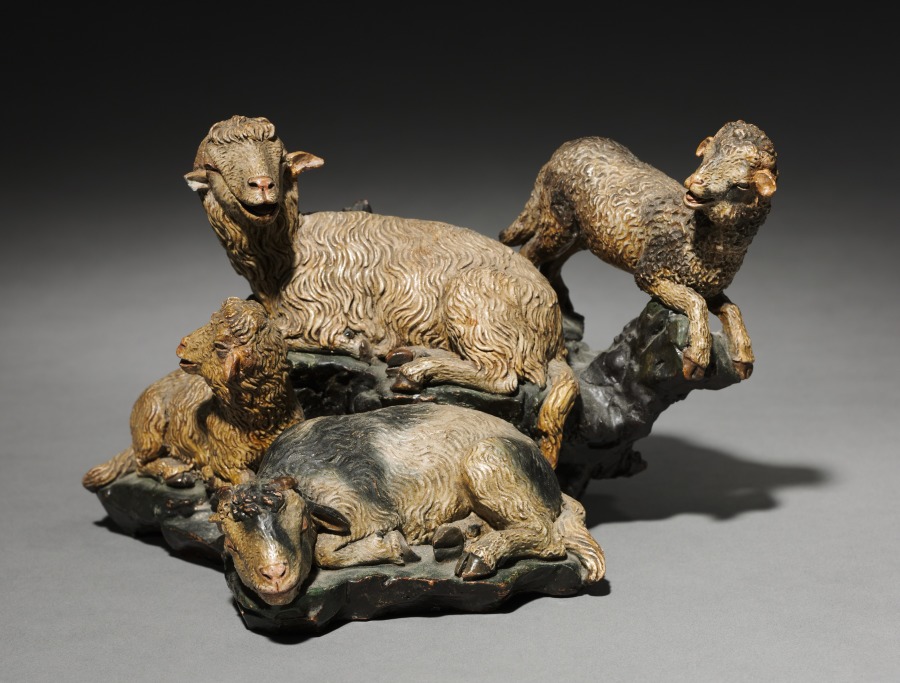
Figure from a Crèche: Group of Four Sheep
- Date
- 1780–1830
- Medium
- painted terracotta
- Culture
- Italy, Naples, late 18th-early 19th century
- Department
- European Painting and Sculpture
- Institution
- Cleveland Museum of Art
- Object ID
- 146991
From the Cleveland Museum of Art record
The practice of creating scenes of the Nativity for the home dates from the early 1700s in Italy, where people began to set up doll-like figures of about a foot or less in height. The custom was particularly popular in Naples around 1800, where crèche scenes (crèche means cradle, or crib) included many figures, whose heads and hands of painted terracotta, stuffed cloth bodies, and clothing adapted from contemporary local costumes gave them an amazingly realistic character. Representations of the birth of Jesus can be traced to the first few centuries of Christianity. Both living creatures and sculptural depictions of them were used from early times. By the late middle ages it was customary to create life-size figures of wood or stone, naturalistically painted, to represent the characters who participated in the events of Jesus's early life. These sculptures were then arranged in scenes illustrating one or both of the most important of these events, the Adoration of the Shepherds and the Adoration of the Magi-the three kings from the East who came to pay homage to the Christ child. Used in churches, these large figures were especially popular in Italy, Central Europe, Spain, and Portugal.
The authoritative record is held by Cleveland Museum of Art. LinkedCulture surfaces this object and its connections; it does not alter institutional metadata.
Get printable QR codesHide QR codes
Open QR codes for this object page and the museum record. They stay collapsed until needed.
Provenance & credit
As published by the source institution. Coverage varies — not every institution's open-data feed includes ownership history.
- Credit line
- Gift of the Womens Council of the Cleveland Museum of Art
- Provenance
- [Lipkin Gallery, London]
Related across collections
Semantically similar works from Cleveland Museum of Art and other institutions.