Cleveland Museum of Art
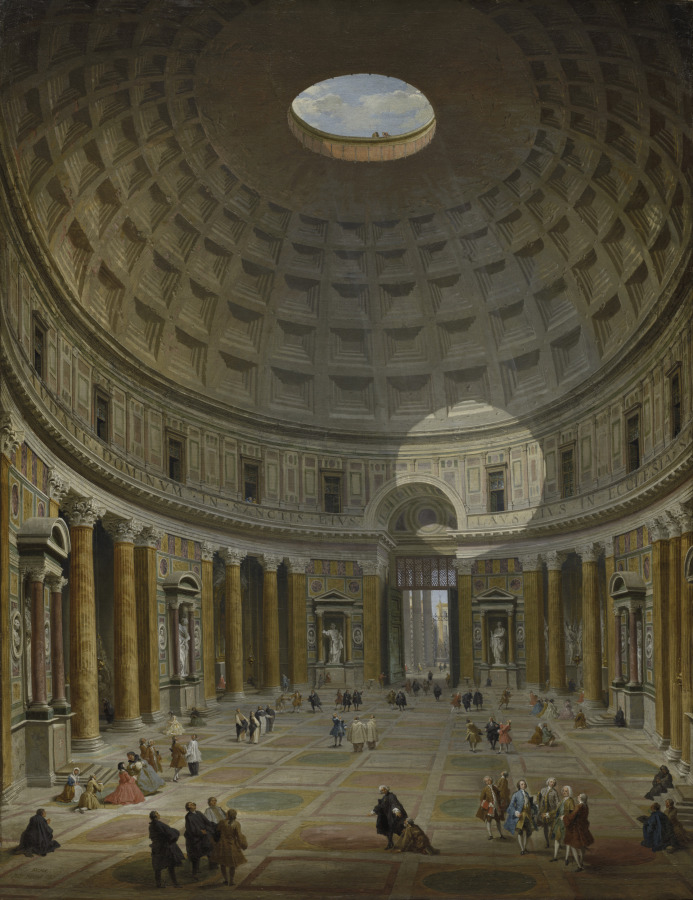
Interior of the Pantheon, Rome
Giovanni Paolo PaniniLinkedCulture matchlcp-f7f7c4c397d8
- Date
- 1747
- Medium
- oil on canvas
- Culture
- Italy, 18th century
- Department
- European Painting and Sculpture
- Institution
- Cleveland Museum of Art
- Object ID
- 147938
From the Cleveland Museum of Art record
Created as a temple under the Roman emperor Hadrian around the year AD 125, the Pantheon became a Christian church in 609. Significant restoration took place in the early 1700s, a period of renewed attention to early Christian monuments. The site was a major monument of antiquity, an active church, and its portico, visible through the door, held the most important art fair in the city. Panini shows the complexity of this public space by representing foreign tourists, local churchgoers, Roman nobles, and artists mingling under the dome. Panini's depictions of contemporary and ancient Rome were popular with foreigners who visited the city on their Grand Tours.
The authoritative record is held by Cleveland Museum of Art. LinkedCulture surfaces this object and its connections; it does not alter institutional metadata.
Get printable QR codesHide QR codes
Open QR codes for this object page and the museum record. They stay collapsed until needed.
Provenance & credit
As published by the source institution. Coverage varies — not every institution's open-data feed includes ownership history.
- Credit line
- Purchase from the J. H. Wade Fund
- Provenance
- Tyrwhitt-Drake ("Shardeloes," Amersham, Buckinghamshire, UK) (sold, Christie’s, London, July 25, 1952, no. 148, to Reder) | 1952 - Reder | David Koetser (New York, New York) | - 1969 Walter P. Chrysler | 1969 - 1974 Eugene V. Thaw (New York, New York), sold to the Cleveland Museum of Art.
Related across collections
Semantically similar works from Cleveland Museum of Art and other institutions.