Cleveland Museum of Art
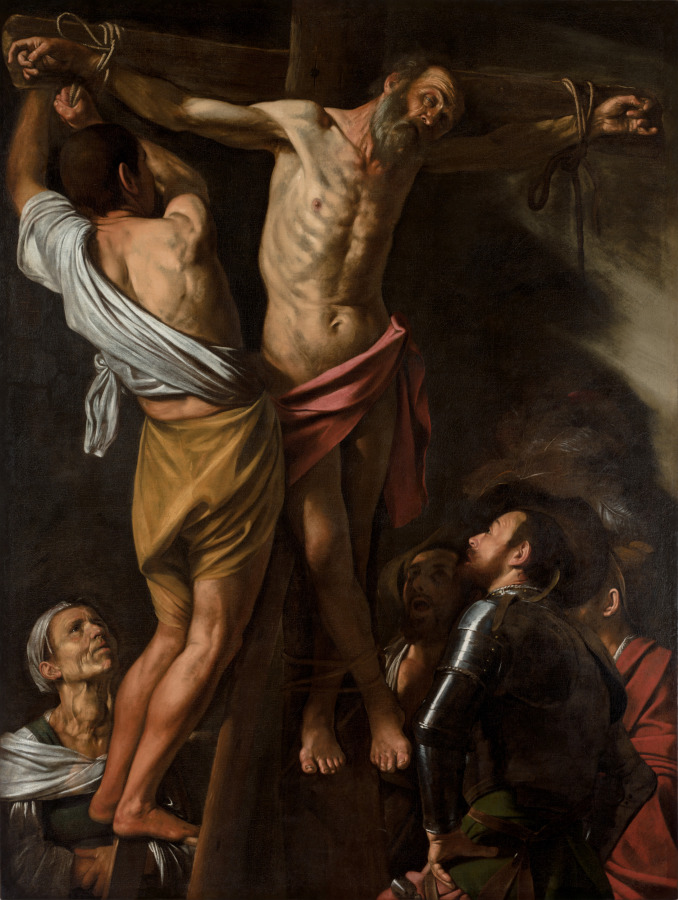
The Crucifixion of Saint Andrew
CaravaggioLinkedCulture matchlcp-a4e2351fd37e
- Date
- 1606–7
- Medium
- oil on canvas
- Culture
- Italy, Naples
- Department
- European Painting and Sculpture
- Institution
- Cleveland Museum of Art
- Object ID
- 148758
From LinkedCulture
A dying man begs his executioners not to save him. In Caravaggio's Crucifixion of Saint Andrew, painted in Naples in 1606 and 1607, an emaciated Andrew hangs on a vertical cross, his gaunt face tilted upward in serene resolve while a muscular executioner reaches helplessly toward the ropes, his hands mysteriously paralyzed. A single beam of light pulls every figure from near-total darkness, drawing the viewer into what feels like a private moment rather than a public spectacle. This oil on canvas is the only altarpiece by Caravaggio in an American collection.
Written by LinkedCulture for its video on this object. Machine-generated (claude-sonnet-4-6), not yet reviewed by a person. It is not part of the museum’s record.
What the image shows
Two men are crucified on a cross, surrounded by onlookers.
Generated by LinkedCulture from the photograph alone, without the museum’s catalogue text (Qwen/Qwen2.5-VL-7B-Instruct), and not yet reviewed by a person. It describes the picture, not the object’s history, and it is not part of the museum’s record.
From the Cleveland Museum of Art record
Saint Andrew’s efforts to introduce Christianity to Greece in the first century CE were met with hostility from local authorities. He was sentenced to die on the cross because he refused to acknowledge pagan gods. For two days, Andrew preached from his martyr’s station to an increasingly sympathetic crowd. Bowing to public demand, Andrew’s would-be executioners attempted to untie him, but their hands were mysteriously paralyzed. Andrew’s desire for martyrdom was thus fulfilled and he died enveloped in divine light. Caravaggio’s innovative interpretation involves the viewer more closely in the event by presenting the crucifixion as intimate and private, rather than as a gruesome public spectacle. Bold contrasts of light and dark suggest the presence of God. A masterpiece of Baroque painting, Caravaggio’s Crucifixion of Saint Andrew is the only altarpiece by the artist in America. Although Saint Andrew is typically associated with an X-shaped cross, here he is depicted on a standard vertical cross.
The authoritative record is held by Cleveland Museum of Art. LinkedCulture surfaces this object and its connections; it does not alter institutional metadata.
Get printable QR codesHide QR codes
Open QR codes for this object page and the museum record. They stay collapsed until needed.
Provenance & credit
As published by the source institution. Coverage varies — not every institution's open-data feed includes ownership history.
- Credit line
- Leonard C. Hanna Jr. Fund
- Provenance
- 1603–1610: Don Juan Alonso Pimentel y Herrera, Eighth Conde de Benavente, Spanish viceroy in Naples. | Don Juan Francisco Alonso Pimentel y Ponce de Léon (grandson of above, inherited) Tenth Conde de Benavente, Valladolid. | An unidentified convent in Castilla, Spain. | A. Tors, Madrid. | 1973: José Manuel Arnaiz, Madrid.
Related across collections
Semantically similar works from Cleveland Museum of Art and other institutions.