Cleveland Museum of Art
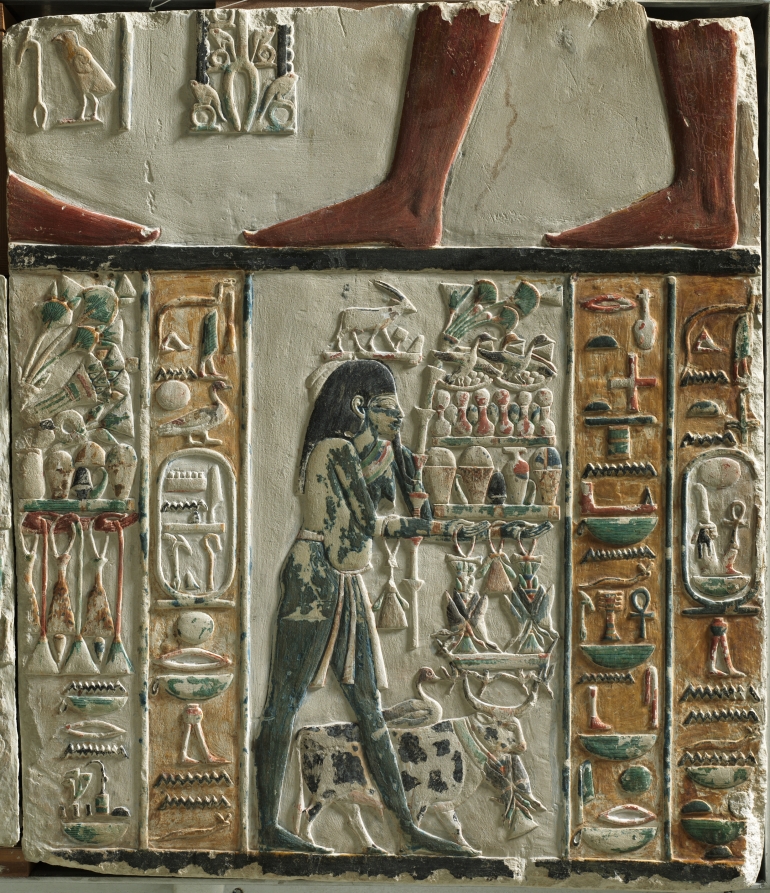
Nome Gods Bearing Offerings
- Date
- c. 1391–1353 BCE
- Medium
- painted limestone
- Culture
- Egypt, New Kingdom (1540–1069 BCE), Dynasty 18, reign of Amenhotep III (1390–1352 BCE)
- Department
- Egyptian and Ancient Near Eastern Art
- Institution
- Cleveland Museum of Art
- Object ID
- 148798
From the Cleveland Museum of Art record
These blocks from a temple wall have preserved their original painted decoration to a remarkable degree. The four portly figures in the lower register bear emblems on their heads identifying them as nomes, or provinces, of ancient Egypt. Carrying trays heaped with offerings and leading sacrificial animals, they personify the bounty of the land. First (on the right) is the Oryx Nome, followed by the Dog Nome, the Falcon Nome, and the Double Scepter Nome. The face of each nome figure is a miniature portrait of Amenhotep III, and each recites a speech in the king's name. The first figure says, "King Nebmaatra [Amenhotep III] has come, bringing to you every good thing that is in this land, that you may give him all life, stability, dominion, and all health from you." The second, third, and fourth figures bring "all greens," "the produce of the Two Lands [Upper and Lower Egypt]," and "all offerings and provisions." The god to whom the nomes bring offerings stood in the fragmentary upper register, facing a standing figure of the king, Amenhotep III. The pair of legs on the right belonged to the god; the single foot on the left belonged to the king. The god held a scepter, forked at the bottom, embellished with coils of rope (for eternity), tadpoles (for hundreds of thousands), and notched palm ribs (for years), the whole signifying "an eternity of hundreds of thousands of years." These blocks may be from Amenhotep III's temple at Kom el-Ahmar, ancient Hebenu, in Middle Egypt, dedicated to the god Horus. Hebenu was the capital of the Oryx Nome, which leads the procession of nome gods. Amenhotep III's temple was later dismantled, and its blocks were reused in the foundations of another structure, which would account for the excellent preservation of the paint. Another block from the same temple wall was acquired 15 years earlier by the museum.
The authoritative record is held by Cleveland Museum of Art. LinkedCulture surfaces this object and its connections; it does not alter institutional metadata.
Get printable QR codesHide QR codes
Open QR codes for this object page and the museum record. They stay collapsed until needed.
Provenance & credit
As published by the source institution. Coverage varies — not every institution's open-data feed includes ownership history.
- Credit line
- John L. Severance Fund
- Provenance
- Probably Kom el-Ahmar, ancient Hebenu. | ?-1976: Miss Frieda Tchacos, Uraeus Gallery, Paris, sold to the Cleveland Museum of Art | 1976-: The Cleveland Museum of Art, Cleveland, OH
Part of a LinkedCulture topic
 Ancient Egyptian Personal Objects
These objects are cosmetic implements and grooming tools from ancient Egypt, including mirrors, palettes for grinding pigments, and decorative knives, representing daily life and personal adornment practices.
476 objects from 5 institutions
Related across collections
Semantically similar works from Cleveland Museum of Art and other institutions.