Cleveland Museum of Art
Reverberations of Taiga, Volume 2 (leaf 25)
Aoki ShukuyaLinkedCulture matchlcp-3bc58d98aeee
- Date
- mid-1700s–1802
- Medium
- double-leaf from a pair of albums; ink and light color on paper
- Culture
- Japan, Edo period (1615–1868)
- Department
- Japanese Art
- Institution
- Cleveland Museum of Art
- Object ID
- 149741
What the image shows
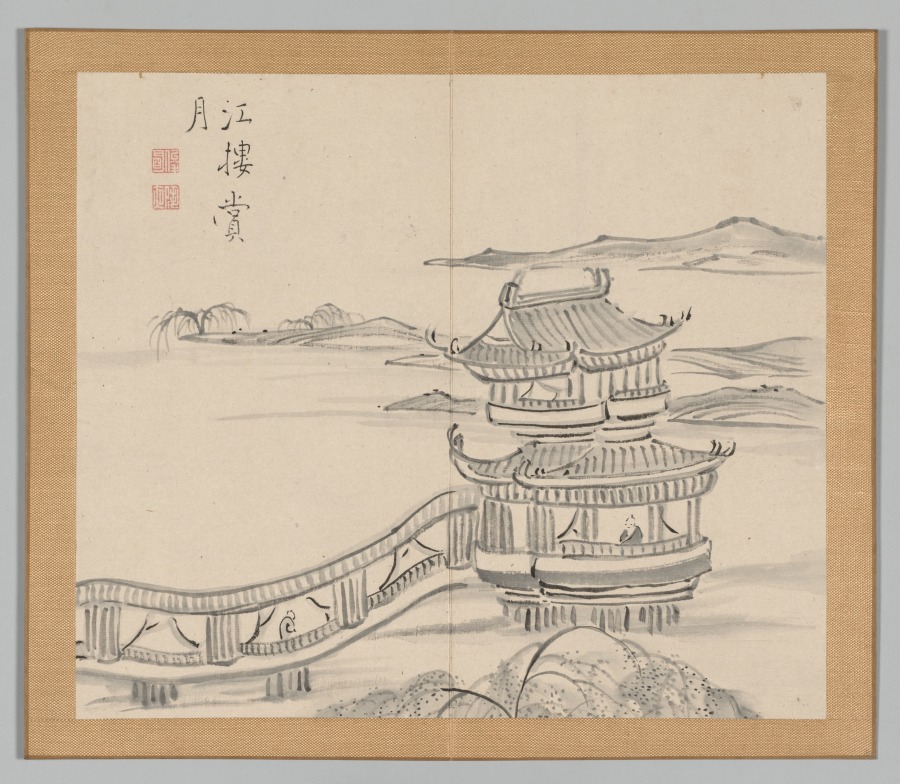
A traditional Chinese pagoda with a curved bridge leading to it, set against a backdrop of mountains and a body of water.
Generated by LinkedCulture from the photograph alone, without the museum’s catalogue text (Qwen/Qwen2.5-VL-7B-Instruct), and not yet reviewed by a person. It describes the picture, not the object’s history, and it is not part of the museum’s record.
From the Cleveland Museum of Art record
Aoki Shukuya was a top student of painter Ike Taiga and took responsibility for Taiga’s stylistic legacy. A painting album by Taiga, part of which survives today in Kyoto in hanging scroll format, served as the source for this painting by Shukuya and the matching designs from a set of wood-block–printed volumes published in 1804. The postscript to the books, written and carved by the scholar Minagawa Kien (皆川淇園) (1735–1807), explains that Taiga produced the original album for his wife and fellow painter Tokuyama Gyokuran (徳山玉瀾) (1727/28–1784). The final design in the first volume of the books and Shukuya’s corresponding painting include the text “viewing the moon from a river pavilion” (江楼賞月). The scene alludes to a poem by Tang dynasty (618–907) poet Zhao Gu (趙嘏) (Chinese, active mid-800s). In the poem, a person gazes at the moon from a riverside pavilion and reflects on the absence of a companion who had admired it with him at the same place the year before. Traditionally, young painters in Japan began their studies with an established master painter. The master's compositions invariably became models that the apprentice copied to learn various ink and brush techniques.
The authoritative record is held by Cleveland Museum of Art. LinkedCulture surfaces this object and its connections; it does not alter institutional metadata.
Get printable QR codesHide QR codes
Open QR codes for this object page and the museum record. They stay collapsed until needed.
Provenance & credit
As published by the source institution. Coverage varies — not every institution's open-data feed includes ownership history.
- Credit line
- Andrew R. and Martha Holden Jennings Fund
- Provenance
- ?–1979: (Katsuhiro Kobayashi, Tokyo, Japan, sold to the Cleveland Museum of Art) | 1979–: The Cleveland Museum of Art, Cleveland, OH
Related across collections
Semantically similar works from Cleveland Museum of Art and other institutions.