Cleveland Museum of Art
Stand-in Fugen
Kitao MasayoshiLinkedCulture matchlcp-d49d3830049b
- Date
- late 1700s–early 1800s
- Medium
- hanging scroll; ink and color on silk
- Culture
- Japan, Edo period (1615–1868)
- Department
- Japanese Art
- Institution
- Cleveland Museum of Art
- Object ID
- 152450
What the image shows
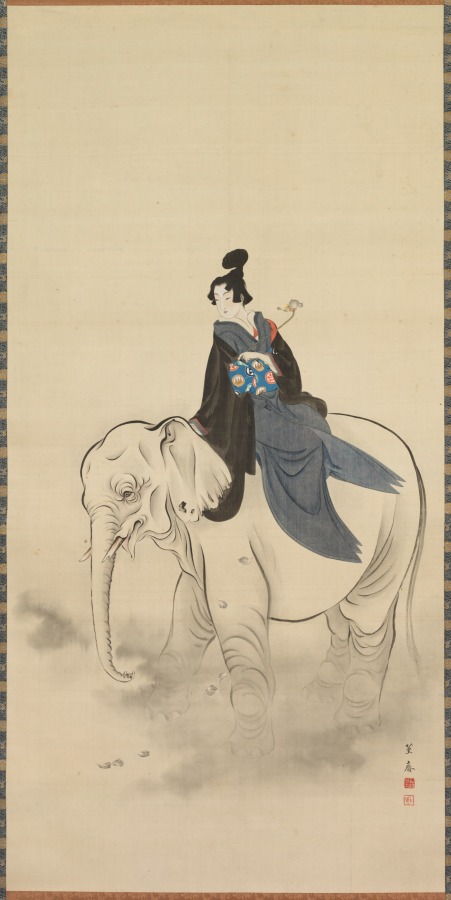
A figure in traditional attire rides an elephant, holding a fan.
Generated by LinkedCulture from the photograph alone, without the museum’s catalogue text (Qwen/Qwen2.5-VL-7B-Instruct), and not yet reviewed by a person. It describes the picture, not the object’s history, and it is not part of the museum’s record.
From the Cleveland Museum of Art record
Here, a woman dressed as a man replaces Fugen, a bodhisattva—a being among those considered enlightened in Buddhism—who symbolizes learning as a path to awakening and typically rides an elephant. The painting teaches the lesson of impermanence through the petals falling from the lotus flower the woman holds. It also alludes to the legend of Eguchi, a 12th-century courtesan who, following an encounter with a Buddhist monk-poet called Saigyō, revealed herself to be a manifestation of Fugen.
The authoritative record is held by Cleveland Museum of Art. LinkedCulture surfaces this object and its connections; it does not alter institutional metadata.
Get printable QR codesHide QR codes
Open QR codes for this object page and the museum record. They stay collapsed until needed.
Provenance & credit
As published by the source institution. Coverage varies — not every institution's open-data feed includes ownership history.
- Credit line
- The Kelvin Smith Collection, given by Mrs. Kelvin Smith
- Provenance
- (Nathan Chaikin, Switzerland, sold to Mr. and Mrs. Kelvin Smith) | ?–1985: The Kelvin Smith Collection, Cleveland, OH, given by Mrs. Kelvin [Eleanor Armstrong] Smith [1899–1998] to the Cleveland Museum of Art | 1985–: The Cleveland Museum of Art, Cleveland, OH
Related across collections
Semantically similar works from Cleveland Museum of Art and other institutions.