Cleveland Museum of Art
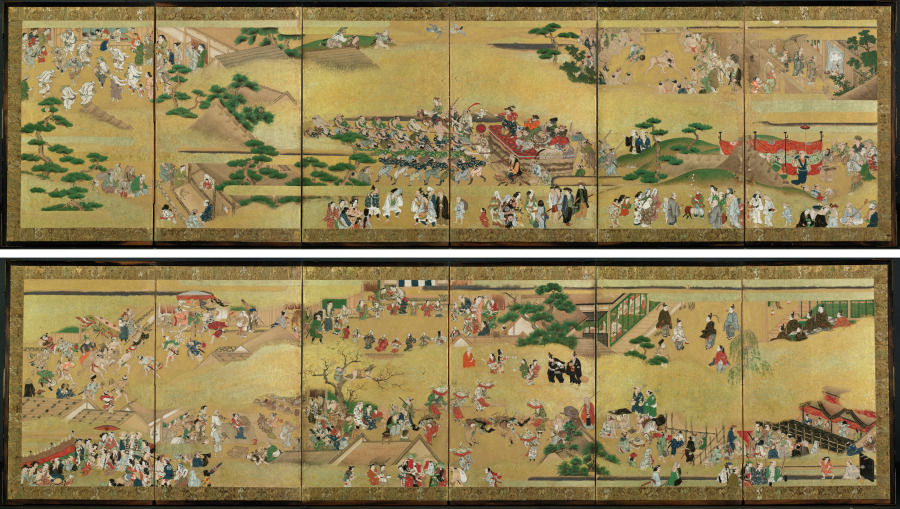
Festival Scenes
- Date
- 1615–99
- Medium
- pair of six-panel folding screens; ink, color, gold, and gold leaf on paper
- Culture
- Japan, Edo period (1615–1868)
- Department
- Japanese Art
- Institution
- Cleveland Museum of Art
- Object ID
- 152451
From the Cleveland Museum of Art record
Much smaller in size than standard Japanese folding screens, this lively pair depicts all manner of entertainments. Although at first they seem to show an ongoing festival, closer examination reveals that the screens comprise a series of isolated scenes from disparate occasions. In one screen, crowds gather around a bout of sumo wrestling as well as juggling and balancing acts. Elsewhere, teams of men pull a float bearing musicians costumed in foreign dress. There is also a dance circle with drums, a performing monkey, and a party of falconers. In the other screen, male courtiers observe a game of kickball played by noblemen, while their female counterparts watch from behind bamboo curtains. Others enjoy a theater performance. A children’s dance circle and a dance performance with ladies sporting elaborate headgear occupy the center of the screen. A group wielding huge parasols at the upper left of the screen reenacts episodes from legend, as still other performances, including dancing dogs, entertain the crowds below.
The authoritative record is held by Cleveland Museum of Art. LinkedCulture surfaces this object and its connections; it does not alter institutional metadata.
Get printable QR codesHide QR codes
Open QR codes for this object page and the museum record. They stay collapsed until needed.
Provenance & credit
As published by the source institution. Coverage varies — not every institution's open-data feed includes ownership history.
- Credit line
- The Kelvin Smith Collection, given by Mrs. Kelvin Smith
- Provenance
- ?–1973: (R. Hosomi, Osaka, Japan, sold to Mr. and Mrs. Kelvin Smith) | 1973–1985: The Kelvin Smith Collection, Cleveland, OH, given by Mrs. Kelvin [Eleanor Armstrong] Smith [1899–1998] to the Cleveland Museum of Art | 1985–: The Cleveland Museum of Art, Cleveland, OH
Related across collections
Semantically similar works from Cleveland Museum of Art and other institutions.