Cleveland Museum of Art
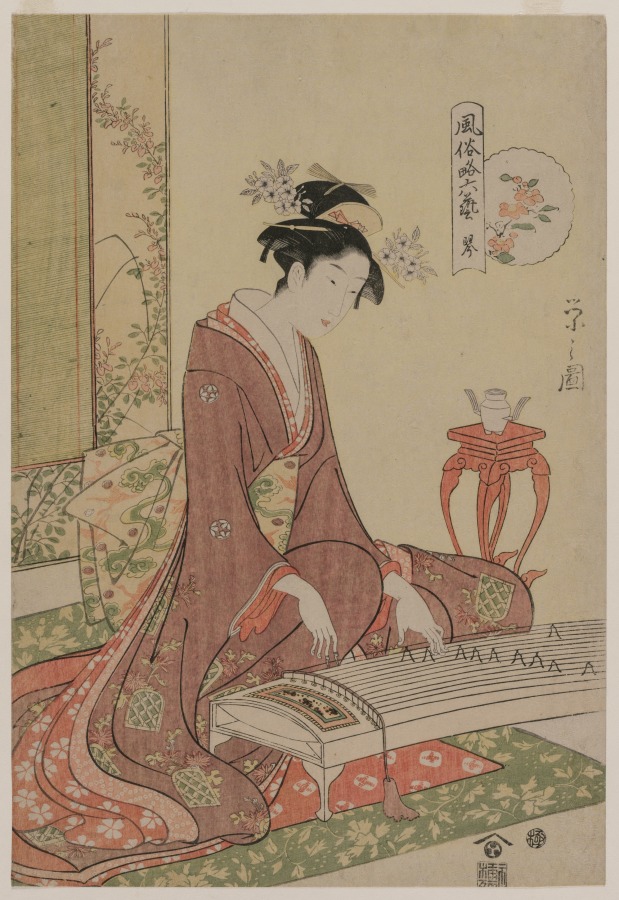
Koto from the series The Six Arts in Fashionable Guise
Chōbunsai EishiLinkedCulture matchlcp-f799399dc8a2
- Date
- c. 1793–96
- Medium
- Color woodblock print; ink and color on paper
- Culture
- Japan, Edo period (1615–1868)
- Department
- Japanese Art
- Institution
- Cleveland Museum of Art
- Object ID
- 152478
What the image shows
A woman in traditional Japanese attire plays a koto harp on a low stool.
Generated by LinkedCulture from the photograph alone, without the museum’s catalogue text (Qwen/Qwen2.5-VL-7B-Instruct), and not yet reviewed by a person. It describes the picture, not the object’s history, and it is not part of the museum’s record.
From the Cleveland Museum of Art record
Chinese classical education consisted of the Six Arts: performing rites, music, archery, charioteering, calligraphy, and mathematics. The Chinese qin, a stringed musical instrument in the zither family, customarily symbolizes the art of music. In this print a similar Japanese instrument, the koto, replaces the qin. The fashionable Japanese entertainer playing it stands in for an accomplished Chinese scholar.
The authoritative record is held by Cleveland Museum of Art. LinkedCulture surfaces this object and its connections; it does not alter institutional metadata.
Get printable QR codesHide QR codes
Open QR codes for this object page and the museum record. They stay collapsed until needed.
Provenance & credit
As published by the source institution. Coverage varies — not every institution's open-data feed includes ownership history.
- Credit line
- The Kelvin Smith Collection, given by Mrs. Kelvin Smith
- Provenance
- Ronald Guthrie McNair Scott [1904 or 1906–1995], consigned to Glendining & Co for sale | April 1, 1960: (Glendining & Co., London, England, April 1, 1960 sale, lot 46) | ?–1972: Hans Popper [1904–1971], consigned to Sotheby Parke Bernet for sale | October 5, 1972: (Sotheby Parke Bernet, New York, NY. "The Hans Popper collection of Japanese prints," October 5, 1972 sale, lot 142) | Eugene V. Thaw [1927–2018], New York, NY, to Kelvin and Eleanor Smith | ?–1985: The Kelvin Smith Collection, Cleveland, OH, given by Mrs. Kelvin [Eleanor Armstrong] Smith [1899–1998] to the Cleveland Museum of Art | 1985–: The Cleveland Museum of Art, Cleveland, OH
Related across collections
Semantically similar works from Cleveland Museum of Art and other institutions.