Cleveland Museum of Art
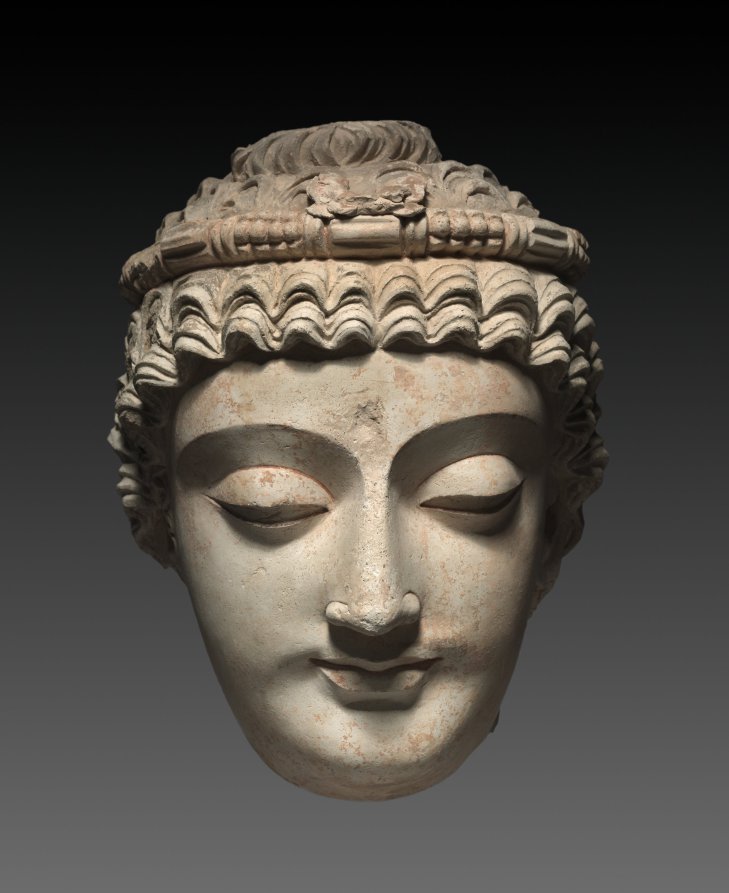
Head of Bodhisattva Avalokiteshvara
- Date
- 300s–400s CE
- Medium
- stucco with traces of paint
- Culture
- Afghanistan or Pakistan, Gandhara, Kushan period
- Department
- Indian and Southeast Asian Art
- Institution
- Cleveland Museum of Art
- Object ID
- 152487
From the Cleveland Museum of Art record
By this period, individual bodhisattvas were beginning to be revered as ideal figures who would deliberately postpone their own enlightenment and entrance into final nirvana, which is a state from which no one returns to be reborn into this world. Bodhisattvas accomplish all but the final meditation leading to full enlightenment, but they are considered to be so advanced in their practice and realization that they have the ability to control their rebirth and act in righteous and compassionate ways to help others achieve enlightenment. Because the remains of a lotus pedestal on which a Buddha sat is at the center of the diadem, this head can be identified as that of the Bodhisattva of Compassion. The idealized linearity of the brows and eyes along with the formalized waves of hair give an ethereal quality to the otherwise naturalistic face.
The authoritative record is held by Cleveland Museum of Art. LinkedCulture surfaces this object and its connections; it does not alter institutional metadata.
Get printable QR codesHide QR codes
Open QR codes for this object page and the museum record. They stay collapsed until needed.
Provenance & credit
As published by the source institution. Coverage varies — not every institution's open-data feed includes ownership history.
- Credit line
- John L. Severance Fund
- Provenance
- ?–1985: (David Tremayne, Ltd., London, UK, sold to the Cleveland Museum of Art) | 1985–: The Cleveland Museum of Art, Cleveland, OH
Related across collections
Semantically similar works from Cleveland Museum of Art and other institutions.