Cleveland Museum of Art
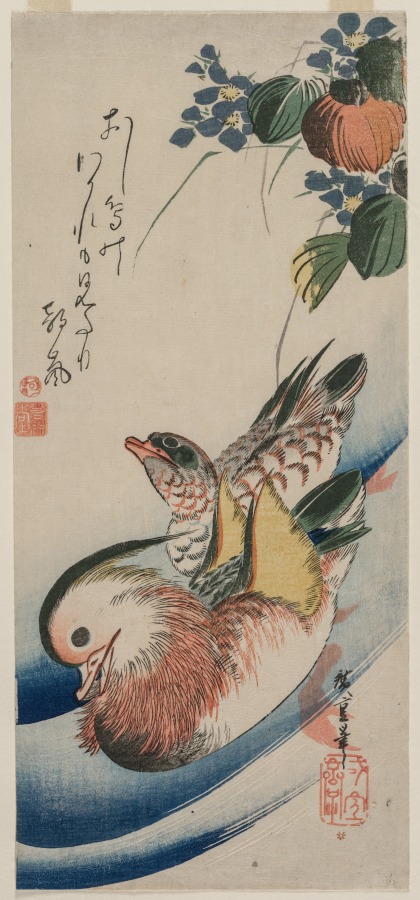
Mandarin Ducks and Flowering Plants
Utagawa HiroshigeLinkedCulture matchlcp-058622c2ea8f
- Date
- early or mid-1830s
- Medium
- color woodblock print
- Culture
- Japan, Edo period (1615–1868)
- Department
- Japanese Art
- Institution
- Cleveland Museum of Art
- Object ID
- 152492
What the image shows
A bird perches on a branch amidst flowers and leaves.
Generated by LinkedCulture from the photograph alone, without the museum’s catalogue text (Qwen/Qwen2.5-VL-7B-Instruct), and not yet reviewed by a person. It describes the picture, not the object’s history, and it is not part of the museum’s record.
From the Cleveland Museum of Art record
In Asian painting, ducks are usually shown in pairs because a male and female mate for life. They symbolize fidelity and tranquility. The presence of another duck is suggested here by the gesture of the bird's head. Notice the variety of brushstrokes and ink tones used to depict the duck's plumage. The bird and flower genre is a popular theme in the paintings and prints of the Kelvin Smith Collection. Kachoga, or bird and flower pictures, became popular among collectors in Japan during the 19th century, due in large part to Hiroshige. Although better known for his landscape prints, Hiroshige made several exceptional prints of birds, plants, and animals that reveal his keen observation of nature.
The authoritative record is held by Cleveland Museum of Art. LinkedCulture surfaces this object and its connections; it does not alter institutional metadata.
Get printable QR codesHide QR codes
Open QR codes for this object page and the museum record. They stay collapsed until needed.
Provenance & credit
As published by the source institution. Coverage varies — not every institution's open-data feed includes ownership history.
- Credit line
- The Kelvin Smith Collection, given by Mrs. Kelvin Smith
- Provenance
- ?-1942: Henri Vever [1854–1942], France | March 26, 1975: (Sotheby & Co., London, UK, March 26, 1975, lot 362) | 1975-?: (R. E. Lewis, Inc., California, sold to Mr. and Mrs. Kelvin Smith) | ?-1985: The Kelvin Smith Collection, Cleveland, OH, given by Mrs. Kelvin [Eleanor Armstrong] Smith [1899-1998] given to the Cleveland Museum of Art | 1985-: The Cleveland Museum of Art, Cleveland, OH
Related across collections
Semantically similar works from Cleveland Museum of Art and other institutions.