Cleveland Museum of Art
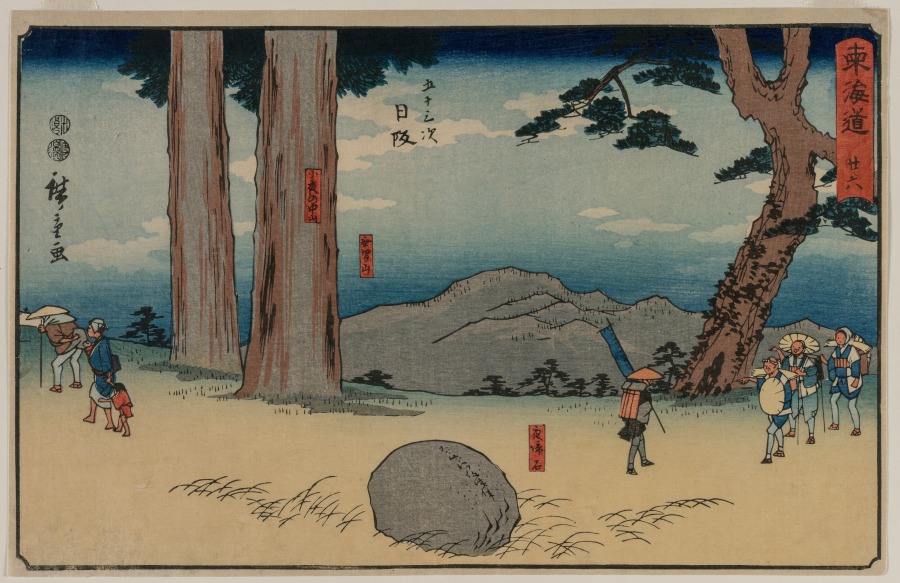
Nissaka: The Night-Weeping Stone at Sayo no Nakayama, from the series The Fifty-Three Stations of the Tōkaidō
Utagawa HiroshigeLinkedCulture matchlcp-058622c2ea8f
- Date
- c. 1848–50
- Medium
- Color woodblock print
- Culture
- Japan, Edo period (1615–1868)
- Department
- Japanese Art
- Institution
- Cleveland Museum of Art
- Object ID
- 152502
What the image shows
A traditional Japanese woodblock print depicting travelers on a path surrounded by trees and mountains.
Generated by LinkedCulture from the photograph alone, without the museum’s catalogue text (Qwen/Qwen2.5-VL-7B-Instruct), and not yet reviewed by a person. It describes the picture, not the object’s history, and it is not part of the museum’s record.
From the Cleveland Museum of Art record
This print is an image of a mountain pass in Nissaka, one of the stops along the Tōkaidō, a road running from Kyoto to Edo (present-day Tokyo). This scene alludes to a legend in which bandits murdered a pregnant woman on that stretch of road, and her blood fell upon a stone. Shown in the foreground, the stone is said to contain the woman’s spirit, and so it weeps each night. In some versions of the story, the stone’s cry alerts a passing monk (really the disguised bodhisattva Kannon) to the presence of her infant, who survived the attack. The monk takes the child from the deceased mother’s body, and raises it as his own. The child goes on to avenge its mother. This print belongs to a series known colloquially as the “Formal Script Tōkaidō” because of the style of text in which the name of the series is printed.
The authoritative record is held by Cleveland Museum of Art. LinkedCulture surfaces this object and its connections; it does not alter institutional metadata.
Get printable QR codesHide QR codes
Open QR codes for this object page and the museum record. They stay collapsed until needed.
Provenance & credit
As published by the source institution. Coverage varies — not every institution's open-data feed includes ownership history.
- Credit line
- The Kelvin Smith Collection, given by Mrs. Kelvin Smith
- Provenance
- (R. E. Lewis, Inc., California, sold to Kelvin and Eleanor Smith) | ?-1985: The Kelvin Smith Collection, Cleveland, OH, given by Mrs. Kelvin [Eleanor Armstrong] Smith [1899-1998] to the Cleveland Museum of Art | 1985-: The Cleveland Museum of Art, Cleveland, OH
Related across collections
Semantically similar works from Cleveland Museum of Art and other institutions.