Cleveland Museum of Art
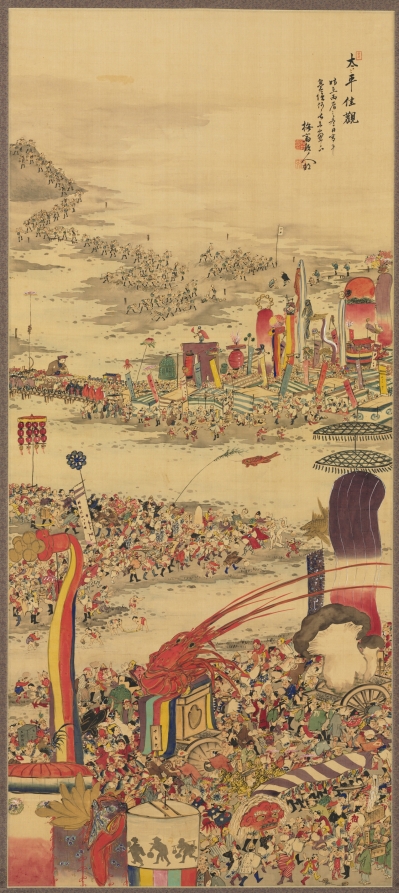
The Sand-Carrying Festival (Sunamochi Matsuri)
Sakai BasaiLinkedCulture matchlcp-a36a912eba96
- Date
- 1856
- Medium
- hanging scroll; ink and color on silk
- Culture
- Japan, Edo period (1615–1868)
- Department
- Japanese Art
- Institution
- Cleveland Museum of Art
- Object ID
- 156111
From the Cleveland Museum of Art record
Dredging waterways to preserve their function once required the cooperation of large numbers of people, seen at the top of this painting. Sand-carrying festivals were historically associated with religious rites or gathering alms to construct places of worship, and involved not only the labor of collecting sand from rivers but also parades and performances marking the event. Kyoto’s Kamo River has been dredged many times over the centuries, including in 1856, the year this image was made. Although the title at the upper right says Taihei Kakan, or “Peaceful, Beautiful View,” the painter’s delightful scene reminds his audience that at the best of times, peace may have little to do with quiet. Sakai Baisai was a student of literati painter Yamamoto Baiitsu (1783–1856). He was active until around 1879, when he relocated to Kobe to make his living as a design painter on porcelains destined for export.
The authoritative record is held by Cleveland Museum of Art. LinkedCulture surfaces this object and its connections; it does not alter institutional metadata.
Get printable QR codesHide QR codes
Open QR codes for this object page and the museum record. They stay collapsed until needed.
Provenance & credit
As published by the source institution. Coverage varies — not every institution's open-data feed includes ownership history.
- Credit line
- Kelvin Smith Fund
- Provenance
- ?–1991: (Andreas Leisinger, Tokyo, Japan, sold to the Cleveland Museum of Art) | 1991–: The Cleveland Museum of Art, Cleveland, OH
Related across collections
Semantically similar works from Cleveland Museum of Art and other institutions.