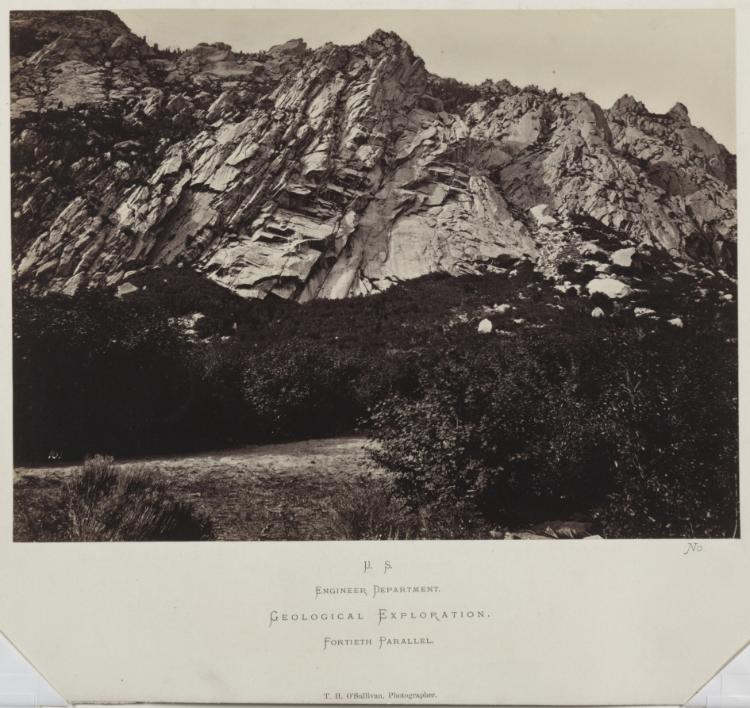
East Humboldt Mountains, Utah

Cleveland Museum of Art

East Humboldt Mountains, Utah

Timothy H. O'Sullivan

Date
1868
Medium
albumen print from wet collodion negative
Culture
America
Department
Photography
Institution
Cleveland Museum of Art

By nature and by experience gained during the Civil War, O’Sullivan was ideally suited for the physical and creative demands required of the official photographer for the geological exploration of the fortieth parallel, led by the enterprising Yale geologist Clarence King. The goal of the expedition was to survey the geological structure and natural resources of a swath of territory 100 miles wide, from the eastern slopes of the Sierra Nevada Mountains across the Great Basin to the Rocky Mountains. While on the expedition in 1867–69 and 1872, O’Sullivan simultaneously pursued his own interest in perfecting a balanced, aesthetic style of landscape photography while providing a faithful record of the natural terrain. As typified in this print, he positioned the camera at a distance parallel to the majestic scenery, presenting a shallow, flattened depiction of space. The image describes in sharp detail the sheer beauty and rugged scale of this Western landscape.

The authoritative record is held by Cleveland Museum of Art. LinkedCulture surfaces this object and its connections; it does not alter institutional metadata.

Related across collections

Semantically similar works from Cleveland Museum of Art and other institutions.

Mono Lake, Volcano, 13,000 Feet

Mono Lake, Volcano, 13,000 Feet

Art Institute of Chicago

Iceberg Canyon, Colorado River Looking Above

Iceberg Canyon, Colorado River Looking Above

Cleveland Museum of Art

Shoshone Falls, Snake River, Idaho, looking through the timber, and showing the main fall, and upper or "Lace Falls", No. 49 from the series "Geographical Explorations and Surveys West of the 100th Meridian"

Shoshone Falls, Snake River, Idaho, looking through the timber, and showing the main fall, and upper or "Lace Falls", No. 49 from the series "Geographical Explorations and Surveys West of the 100th Meridian"

Art Institute of Chicago

Black Canyon, Colorado River, Looking Above from Mirror Bar

Black Canyon, Colorado River, Looking Above from Mirror Bar

Minneapolis Institute of Art

Camp Beauty, Canñon de Chelle; walls 1.200 feet high, width of Cañon at this point about one fourth of a mile. This view shows the perpendicular effect wrought by the action of floods. The Artist of the Expedition, Mr. Wyant, of New York, made a study of this scene with the intention to paint it as a characteristic Canon view, No. 25 from the series "Geographical Explorations and Surveys West of the 100th Meridian"

Camp Beauty, Canñon de Chelle; walls 1.200 feet high, width of Cañon at this point about one fourth of a mile. This view shows the perpendicular effect wrought by the action of floods. The Artist of the Expedition, Mr. Wyant, of New York, made a study of this scene with the intention to paint it as a characteristic Canon view, No. 25 from the series "Geographical Explorations and Surveys West of the 100th Meridian"

Art Institute of Chicago

Historic Spanish Record of the Conquest, South Side of Inscription Rock, N.M.

Historic Spanish Record of the Conquest, South Side of Inscription Rock, N.M.

Art Institute of Chicago

Rain Sculpture, Salt Creek Canon, Utah

Rain Sculpture, Salt Creek Canon, Utah

Art Institute of Chicago

Alpine lakes, and mountain scenery, in the Cerro Blanco Mountains, Colorado, 13.000 feet above sea-level, No. 47 from the series "Geographical Explorations and Surveys West of the 100th Meridian"

Alpine lakes, and mountain scenery, in the Cerro Blanco Mountains, Colorado, 13.000 feet above sea-level, No. 47 from the series "Geographical Explorations and Surveys West of the 100th Meridian"

Art Institute of Chicago

Ancient Ruins in the Cañon de Chelle, N.M. In a niche 50 feet above present Cañon bed.

Ancient Ruins in the Cañon de Chelle, N.M. In a niche 50 feet above present Cañon bed.

Art Institute of Chicago

Geographical Explorations and Surveys West of the 100th Meridian

Geographical Explorations and Surveys West of the 100th Meridian

Art Institute of Chicago

Distant View of Explorers Column, Canon de Chelle, about 900 ft. in height.

Distant View of Explorers Column, Canon de Chelle, about 900 ft. in height.

Getty Museum

Central portion of Canñon de Chelle, New Mexico. This Canñon is one of the most remarkable in the west, and is noted for its beauty. The walls are of Red Sand-stone, nearly perpendicular, and at this point are 1.200 feet in height, No. 24 from the series "Geographical Explorations and Surveys West of the 100th Meridian"

Central portion of Canñon de Chelle, New Mexico. This Canñon is one of the most remarkable in the west, and is noted for its beauty. The walls are of Red Sand-stone, nearly perpendicular, and at this point are 1.200 feet in height, No. 24 from the series "Geographical Explorations and Surveys West of the 100th Meridian"

Art Institute of Chicago