Cleveland Museum of Art
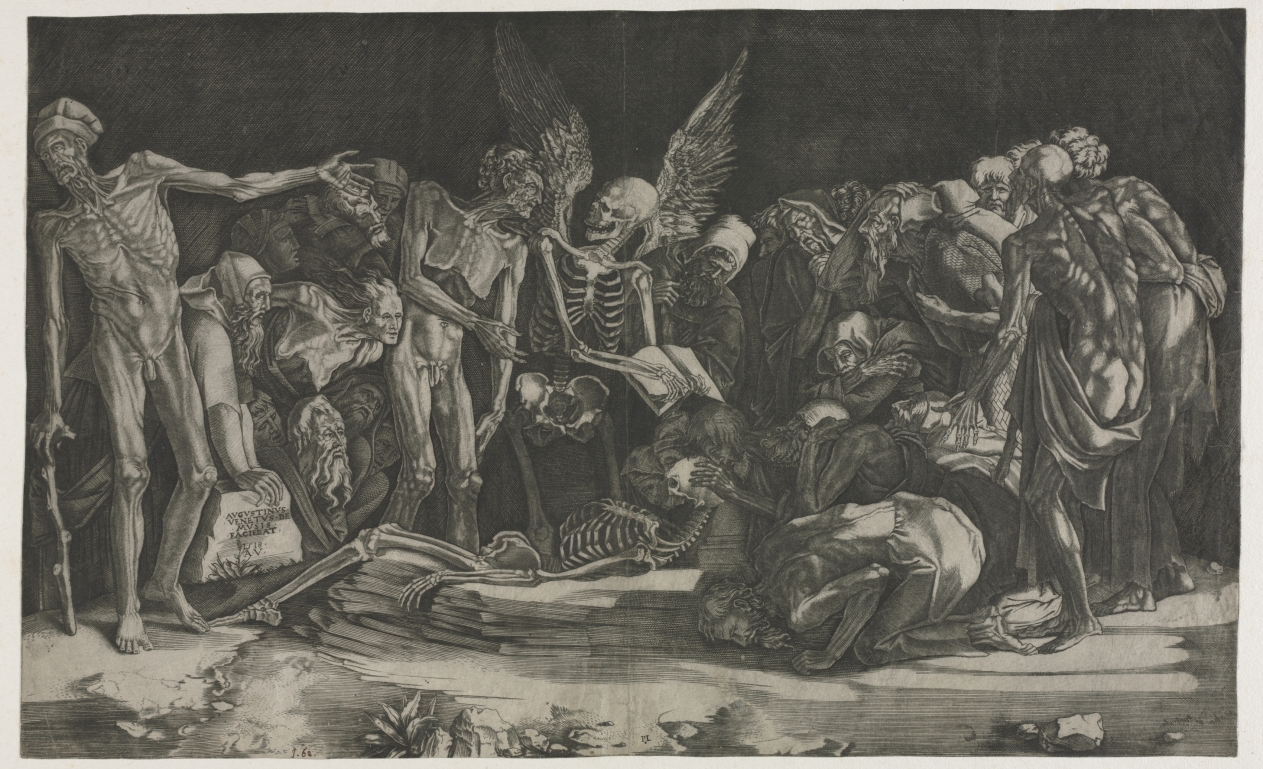
Skeletons, also known as Allegory of Death and Fame
Agostino VenezianoLinkedCulture matchlcp-67654a35c494
- Date
- 1518
- Medium
- engraving
- Culture
- Italy, 16th century
- Department
- Prints
- Institution
- Cleveland Museum of Art
- Object ID
- 157194
From the Cleveland Museum of Art record
Although for centuries scholars have attempted to understand the allegorical meaning of this print, 16th-century artist and author Giorgio Vasari described it simply as “an anatomy of desiccated nudes and of bones of the dead.” A central figure of winged Death stands over an interred skeleton, surrounded by a variety of skeletal and living human figures who appear to debate the fate of the soul. At far left is a “marasmic” man, a type of sun-dried body used by anatomists to study the muscles without removing the skin. Rosso Fiorentino, who designed the composition of this print to be engraved by Agostino Veneziano, was a Florentine contemporary of Michelangelo who planned a book on anatomy that was never published.
The authoritative record is held by Cleveland Museum of Art. LinkedCulture surfaces this object and its connections; it does not alter institutional metadata.
Get printable QR codesHide QR codes
Open QR codes for this object page and the museum record. They stay collapsed until needed.
Provenance & credit
As published by the source institution. Coverage varies — not every institution's open-data feed includes ownership history.
- Credit line
- Andrew R. and Martha Holden Jennings Fund
- Provenance
- Sir Peter Lely (1618-1680), London, stamp (Lugt 2092), lower center, in black ; Duke of Devonshire, Chatsworth, sold: Christie's, London, Dec. 5, 1985, lot 71, repr. ; purchased from (R.M. Light & Co., Santa Barbara, CA)
Related across collections
Semantically similar works from Cleveland Museum of Art and other institutions.