Cleveland Museum of Art
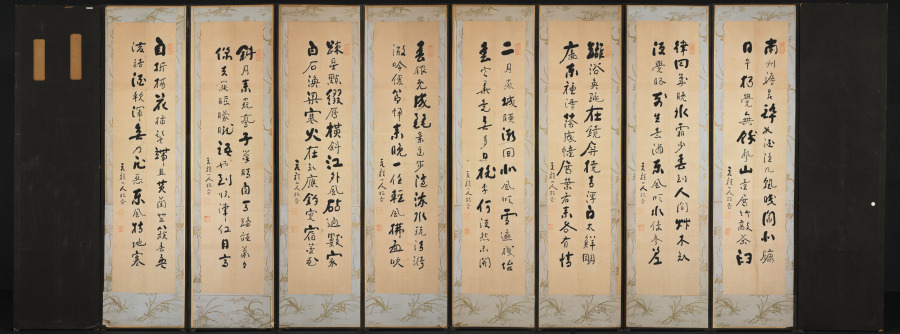
Calligraphy (reverse)
- Date
- late 1800s
- Medium
- Ten-panel folding screen affixed with album leaves (obverse), calligraphy (reverse), ink and color on silk
- Culture
- Korea, Joseon dynasty (1392–1910)
- Department
- Korean Art
- Institution
- Cleveland Museum of Art
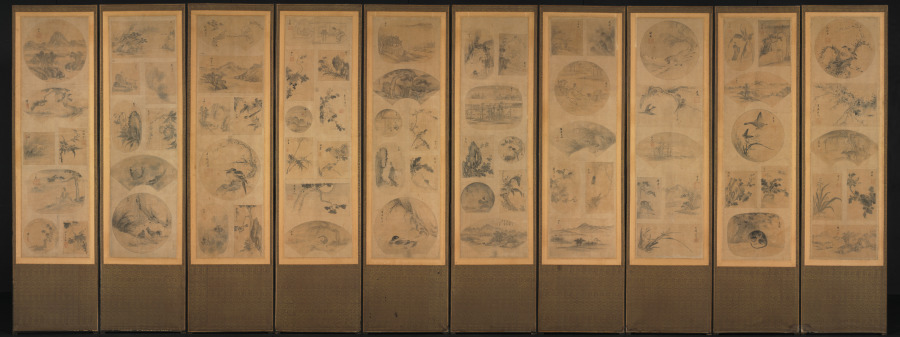
The front of this screen features an assortment of subjects: birds and flowers, landscapes, and scenes of everyday life, mostly in monochromatic ink with light colors. The screen’s reverse side conveys a number of classical poems about the fleeting beauty of the four seasons. Traditionally, only one side of a folding screen bears painted or embroidered images, since these were used as a background furnishing. In Korean houses by the 1800s and early 1900s, however, two-sided folding screens became noticeably popular, possibly inspired by Japanese double-sided folding screens, which mainly served as room dividers in Japanese households. A calligrapher has brushed several Chinese poems about the four seasons on the reverse side, among them "Composing in the Daytime of Summer" by Tang poet Liu Zongyuan (773–819) and "Composing when Spring Begins" by Song scholar Zhang Shi (1133–1180).
The authoritative record is held by Cleveland Museum of Art. LinkedCulture surfaces this object and its connections; it does not alter institutional metadata.
Related across collections
Semantically similar works from Cleveland Museum of Art and other institutions.
Painting of One Hundred Themes (obverse)
Cleveland Museum of Art
Painting of One Hundred Themes
Cleveland Museum of Art
![Spring and Summer [right of a pair of Landscapes of the Four Seasons]](https://2.api.artsmia.org/800/60174.jpg)
Spring and Summer [right of a pair of Landscapes of the Four Seasons]
Minneapolis Institute of Art
![Bamboo and Chinese Poems [left of a pair]](https://0.api.artsmia.org/800/118363.jpg)
Bamboo and Chinese Poems [left of a pair]
Minneapolis Institute of Art
![Bamboo and Chinese Poems [right of a pair]](https://1.api.artsmia.org/800/118364.jpg)
Bamboo and Chinese Poems [right of a pair]
Minneapolis Institute of Art

Landscape with Spring Scenery
Minneapolis Institute of Art
![The Four Accomplishments [right of a pair]](https://1.api.artsmia.org/800/118455.jpg)
The Four Accomplishments [right of a pair]
Minneapolis Institute of Art
![The Four Accomplishments [left of a pair]](https://2.api.artsmia.org/800/118456.jpg)
The Four Accomplishments [left of a pair]
Minneapolis Institute of Art

Mountain Landscape in Autumn and Winter
Minneapolis Institute of Art
![Chang'an [left of a pair]](https://0.api.artsmia.org/800/117747.jpg)
Chang'an [left of a pair]
Minneapolis Institute of Art
![Chang'an [right of a pair]](https://6.api.artsmia.org/800/117746.jpg)
Chang'an [right of a pair]
Minneapolis Institute of Art
Landscape of the Four Seasons
Art Institute of Chicago