Cleveland Museum of Art
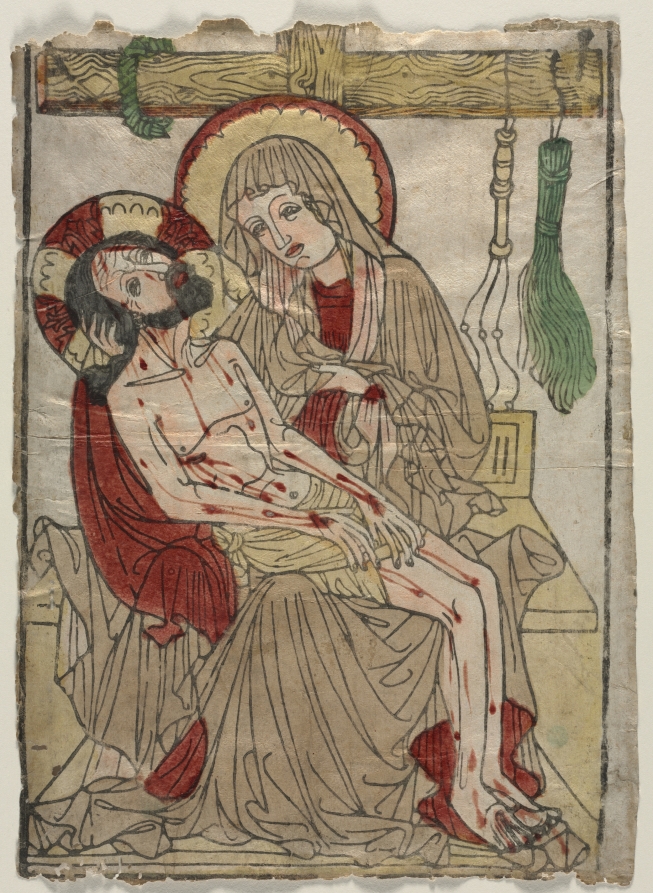
Pietà
- Date
- c. 1460
- Medium
- woodcut, hand colored with watercolor
- Culture
- Southern Germany, Swabia, 15th century
- Department
- Prints
- Institution
- Cleveland Museum of Art
- Object ID
- 162306
From the Cleveland Museum of Art record
Early woodcuts usually illustrate religious subjects for the spiritual edification and contemplative meditation of a mostly illiterate public. Produced by anonymous craftsmen, these simple, direct images facilitated an intimate dialogue between the individual and the holy figure depicted. Here, a youthful Virgin Mary delicately embraces her dead son’s body, with its hand-colored flesh and drops of blood. Behind her, the wooden cross displays the Instruments of the Passion of Christ: two nails, the crown of thorns, and two scourges. By stressing the humanity of Mary’s grief over her son’s suffering and death, the print encourages an empathetic response from the beholder. This pietà was probably inspired by sculptures of the subject, common in Germany. Printed on a full sheet of paper, the image was hand colored with watercolor. Remnants of adhesive on the verso and holes caused by insects suggest that it was pasted inside the cover of a book, which preserved it. There are only about 20 northern single-image woodcuts extant. Extraordinary in its large size, fresh color, and good state of preservation, this sheet is the only known impression of the image. In this single-leaf woodcut, Mary’s left hand engages her headscarf in a gesture known as the tuchlein-geste , an act anticipating the wiping away of tears.
The authoritative record is held by Cleveland Museum of Art. LinkedCulture surfaces this object and its connections; it does not alter institutional metadata.
Get printable QR codesHide QR codes
Open QR codes for this object page and the museum record. They stay collapsed until needed.
Provenance & credit
As published by the source institution. Coverage varies — not every institution's open-data feed includes ownership history.
- Credit line
- Severance and Greta Millikin Trust
- Provenance
- [Sotheby's, London, June 27th, 1988, lot 65]; [N.G. Stogdon, London, German and Netherlandish Woodcuts of the 15th and 16th Centuries, 1991, cat. no 1]; Idemitsu Corporation Museum, Tokyo; [Christie's, London, July 3, 2001, lot 31], bought by N.G. Stogdon and Bob Light
Related across collections
Semantically similar works from Cleveland Museum of Art and other institutions.