Cleveland Museum of Art
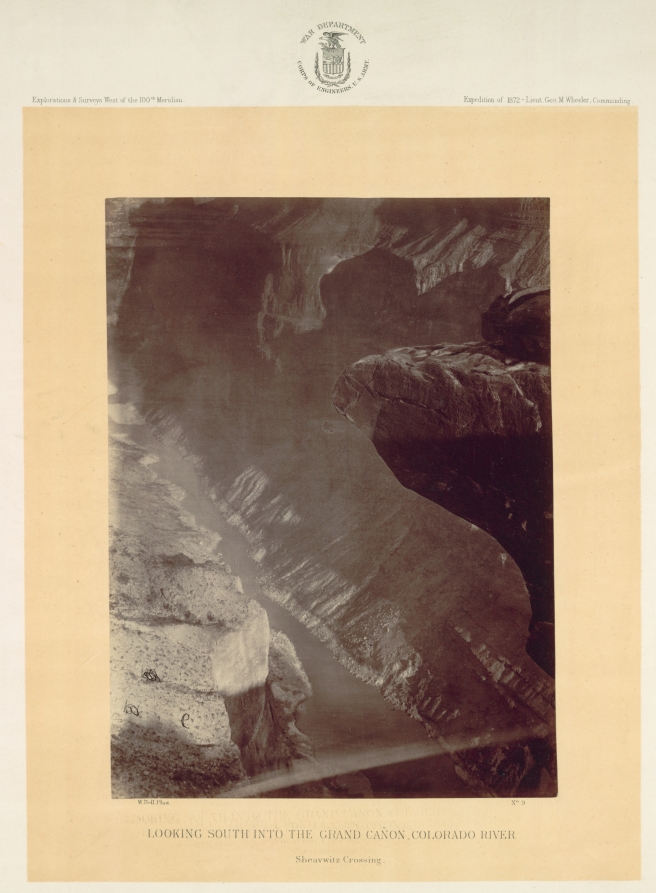
Looking South into the Grand Canyon, Colorado River, Sheavwitz
William H. BellLinkedCulture matchlcp-0705dfac06d0
- Date
- 1872
- Medium
- albumen print from wet collodion negative
- Culture
- America
- Department
- Photography
- Institution
- Cleveland Museum of Art
- Object ID
- 162315
From the Cleveland Museum of Art record
From 1871 to 1873, General George M. Wheeler led the government-sponsored survey of lands west of the 100th meridian. Philadelphian William Bell served as the new staff photographer for the expedition into Arizona. Bell used dry plates of his own manufacture instead of the popular wet collodion process, thus freeing himself from the necessity of having a darkroom nearby whenever he wanted to expose a negative. The photographer's style was to create dramatic compositions emphasizing verticality. In this surprising juxtaposition of scale and perspective, he captured the sensation experienced by a spectator gazing down into a vast canyon below. Bell carefully included jutting rocks in the foreground to anchor the plunging perspective view down to the river. Glaring contrasts of light and shadow enrich the composition, focusing on the powerful forces of nature that created this rugged landscape.
The authoritative record is held by Cleveland Museum of Art. LinkedCulture surfaces this object and its connections; it does not alter institutional metadata.
Get printable QR codesHide QR codes
Open QR codes for this object page and the museum record. They stay collapsed until needed.
Provenance & credit
As published by the source institution. Coverage varies — not every institution's open-data feed includes ownership history.
- Credit line
- John L. Severance Fund
Related across collections
Semantically similar works from Cleveland Museum of Art and other institutions.