Cleveland Museum of Art
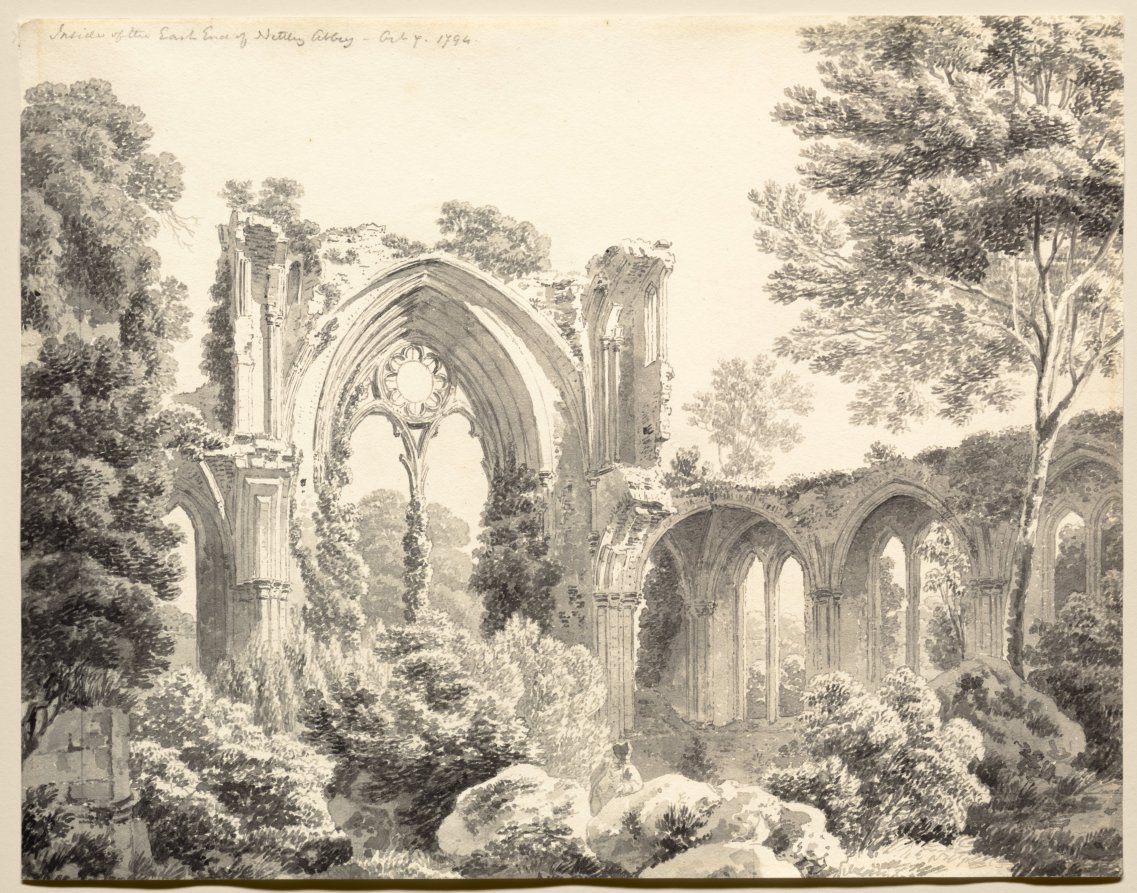
Inside the East End of Nettley Abbey
Michel Angelo RookerLinkedCulture matchlcp-a86e7d0cbed9
- Date
- 1794
- Medium
- gray wash with extensive point of brush with traces of graphite; squared with graphite
- Culture
- England, 18th century
- Department
- Drawings
- Institution
- Cleveland Museum of Art
- Object ID
- 163792
From the Cleveland Museum of Art record
By the end of the 18th century, Britain’s medieval ruins had become popular tourist destinations and a rich source of inspiration for Romantic poets and painters, establishing a veritable "cult of ruins." Decaying Gothic architecture set in overgrown landscapes conjured thoughts of the transience of human ambition in the context of eternal nature. In 1755, the writer and Whig politician Horace Walpole described Netley Abbey: "The ruins are vast . . . with all variety of Gothic patterns of windows wrapped round and round with ivy—many trees are sprouted up against the walls and want only to be increased with cypresses! In short, they are not the ruins of Netley, but of Paradise." Michael Angelo Rooker’s drawing gives form to Walpole’s description of his magical visit to the ruined abbey. Netley Abbey, seen in this drawing, was a popular subject in art and literature at the time Michael Angelo Rooker depicted it.
The authoritative record is held by Cleveland Museum of Art. LinkedCulture surfaces this object and its connections; it does not alter institutional metadata.
Get printable QR codesHide QR codes
Open QR codes for this object page and the museum record. They stay collapsed until needed.
Provenance & credit
As published by the source institution. Coverage varies — not every institution's open-data feed includes ownership history.
- Credit line
- Gift of the Painting and Drawing Society of The Cleveland Museum of Art
- Provenance
- 1965: (sale, Christie's, London, November 16, 1965, no. 174) | after 1965-before 1984: J. Dayes, Esq. | 1984: (sale, Sotheby's, London, November 21, 1984, no. 88) | after 1984-before 2005: Harry and Nina Pollock, Cleveland Heights, OH | 2005: Painting and Drawing Society, Cleveland Museum of Art, Cleveland, OH, given to the Cleveland Museum of Art, Cleveland, OH | 2005-: Cleveland Museum of Art, Cleveland, OH
Related across collections
Semantically similar works from Cleveland Museum of Art and other institutions.