Cleveland Museum of Art
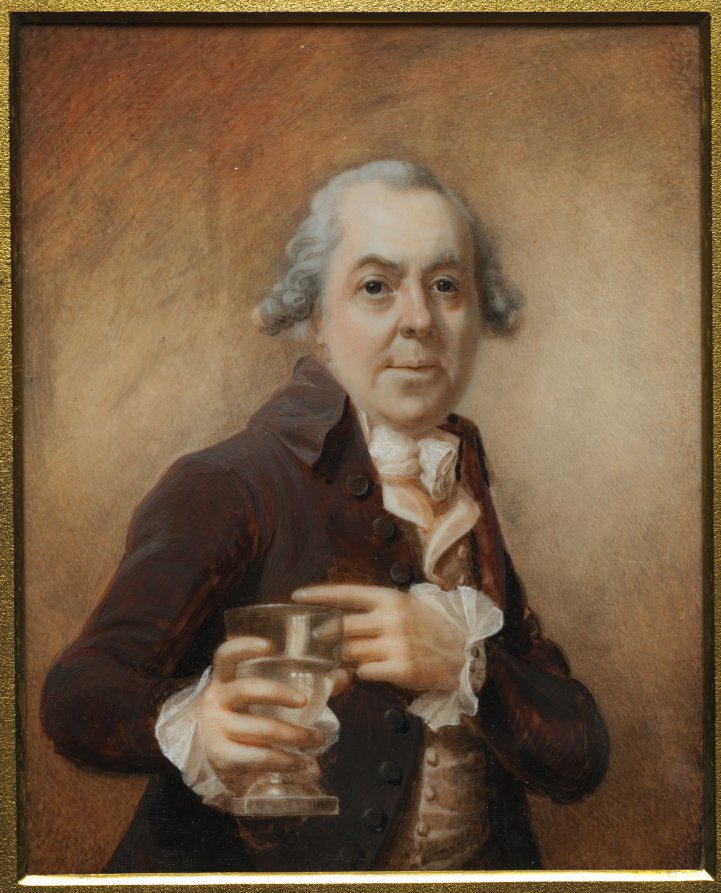
Portrait of a Man Holding a Glass
Joseph DanielLinkedCulture matchlcp-6567d709746c
- Date
- c. 1780s
- Medium
- watercolor on ivory
- Culture
- England, late 18th century
- Department
- European Painting and Sculpture
- Institution
- Cleveland Museum of Art
- Object ID
- 168810
From the Cleveland Museum of Art record
Joseph Daniel was the son Nochaniah Daniel of Bridgewater, Somerset, and among the first known Jewish artists of South West England. Joseph’s work has often been confused with that of his brother Abraham, with whom he competed for patronage. Neither commonly used his forename in signature nor in advertisement, possibly with a view to capitalize on the other’s clientele. Little is known about the brothers’ education apart from the fact that they were trained by their mother. Joseph seldom exhibited his miniatures in public. Only in recent years has there been an increased confidence in distinguishing his works from those of Abraham, resulting from the discovery of a handful of miniatures signed with first initials. The primary distinction between their styles is usually cited as Joseph’s greater attention to detail and his use of gray tones in shading. This outstanding miniature dating from the 1780s is unsigned, as was typical of Daniel’s practice. The sitter is conventionally dressed, wearing a powdered wig and a cream-colored cravat and waistcoat under a dark brown frock coat against which the delicacy of the translucent frilled cuffs is especially pronounced. There is evidence on the painted surface that Daniel adjusted the position of the index finger on the man’s left hand as well as the rightmost curls of his wig. The background is a mottled rusty brown, spot lit to pale brown in the center. The pallor of the sitter’s face, framed by gray hair and a blanched background, reinforces the intensity of his dark eyes, which confront the viewer directly. The face is sensitively described with broad gray shadows. Daniel’s attention to detail is evident in the reflection of the window in the curved glass of the goblet. The goblet, while acting as a central element in the picture, is not a refined object; instead, it is a heavy, plain vessel significant for its contents: water from Bath’s natural hot springs. This type of virtuoso portrait may have been displayed in the artist’s studio to attract clients and refers to the spa culture of Bath, a critical site for social maneuvering in eighteenth- and early-nineteenth-century England. While some highly successful artists were able to support themselves by working only in miniature, it was more common for them to work in a variety of media like Joseph Daniel who was a miniature painter, engraver, and jeweler who also executed pictures in oil, crayon, and hairwork.
The authoritative record is held by Cleveland Museum of Art. LinkedCulture surfaces this object and its connections; it does not alter institutional metadata.
Get printable QR codesHide QR codes
Open QR codes for this object page and the museum record. They stay collapsed until needed.
Provenance & credit
As published by the source institution. Coverage varies — not every institution's open-data feed includes ownership history.
- Credit line
- Leonard C. Hanna Jr. Fund
- Provenance
- 1972: The Merchiston Collection, purchased by Mrs. Eleanor Hamilton (née Strachan, b. 1933, Scotland) from an unknown source | November 25, 2009: Sale: "The Merchiston Collection Sale", Bonhams, Knightsbridge, November 25, 2009, lot 25 | 2009-: The Cleveland Museum of Art, Cleveland, OH
Part of a LinkedCulture topic
 English Portrait Miniatures
A collection of portrait miniatures from 17th-18th century England, predominantly featuring watercolor on ivory or graphite and wash techniques, representing the tradition of intimate personal portraiture in miniature fo
221 objects from 4 institutions
Related across collections
Semantically similar works from Cleveland Museum of Art and other institutions.