Cleveland Museum of Art
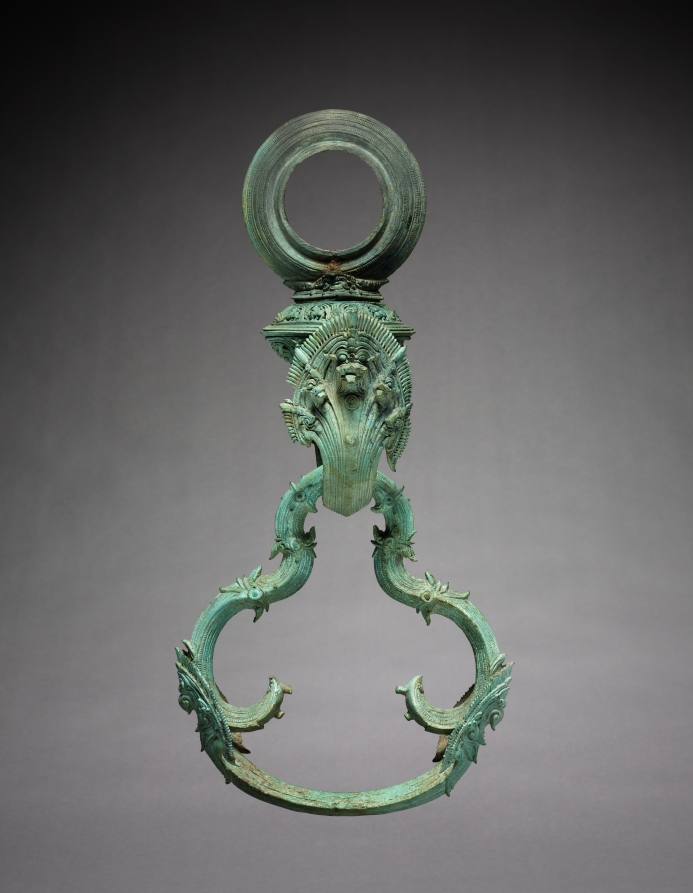
One of a Pair of Decorated Palanquin Hooks and Rings
- Date
- 1100–1175
- Medium
- bronze
- Culture
- Cambodia, Angkor Wat Style, 12th century
- Department
- Indian and Southeast Asian Art
- Institution
- Cleveland Museum of Art
- Object ID
- 169260
From the Cleveland Museum of Art record
Hooks, suspension rings, and finials cast in bronze are very common fixtures in Cambodian decorative art. Frequently they served a practical function, such as the present set, used for a palanquin in which a person was carried from place to place. The litter or throne was fastened to the rings which in turn were suspended from the books fixed by bolts to transverse poles carried on the shoulders of the palanquin bearers. Chariots, palanquins, furniture, and harnesses were frequently embellished with various bronze decorations, finials, and fixtures. Those, as a rule, were gilded, making the objects they served look very sumptuous. The relief sculpture found on various Khmer monuments, such as Angkor Wat or Bayon, illustrates well the use and context of those bronze implements in ancient Cambodian life. These frequently elaborate bronze fixtures were decorated with motifs generally popular in Cambodian art: such as nagas , garudas , floral, or animal patterns. This pair of hooks and rings, unusually large in size, take on a naga form in the hooks. They are decorated with perforated floral and animal motifs done with great care and precision. The rings, suspended from hooks, are in the form of tri-fold flower stalks with naga motifs repeated at the end of the curved stalks. Such elaborate and huge hooks and rings must have no doubt decorated a palanquin of an important individual, possible a ruler himself. Their decoration is typical of the mature Angkor Wat style. The naga , a water serpent with a multiheaded hood, is a Khmer national emblem.
The authoritative record is held by Cleveland Museum of Art. LinkedCulture surfaces this object and its connections; it does not alter institutional metadata.
Get printable QR codesHide QR codes
Open QR codes for this object page and the museum record. They stay collapsed until needed.
Provenance & credit
As published by the source institution. Coverage varies — not every institution's open-data feed includes ownership history.
- Credit line
- Gift of Maxeen and John Flower in honor of Dr. Stanislaw Czuma
- Provenance
- ?–February 1988: (Chai Ma Antiques, Bangkok, Thailand, sold to Maxeen Flower) | February 1988–2011: Dr. John and Maxeen Stone Flower [1928–2010], Shaker Heights, OH, bequest to the Cleveland Museum of Art | 2011–: The Cleveland Museum of Art, Cleveland, OH
Related across collections
Semantically similar works from Cleveland Museum of Art and other institutions.