Cleveland Museum of Art
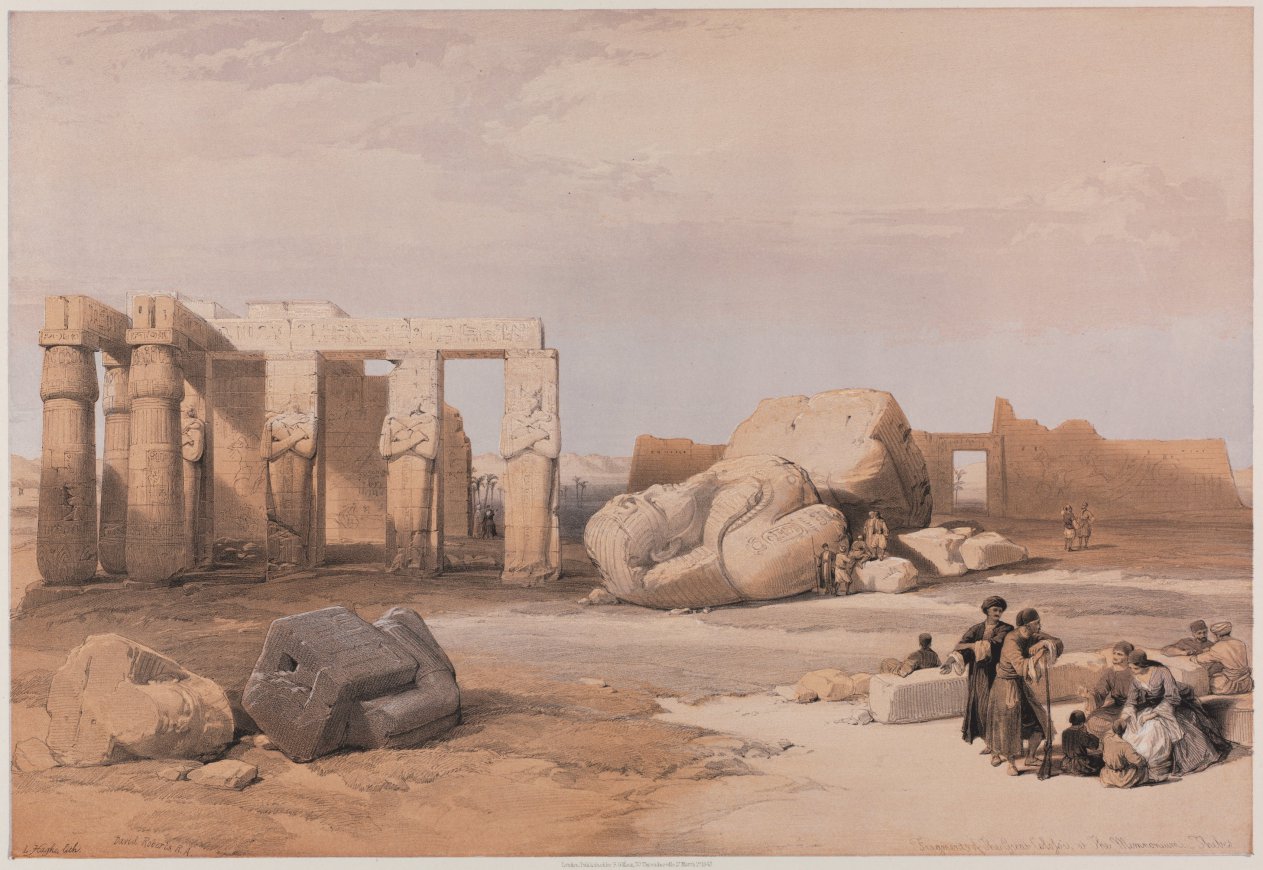
Egypt and Nubia, Volume II: Fragments of the Great Colossi at the Memnonium, Thebes
Louis HagheLinkedCulture matchlcp-5386dbd57371
- Date
- 1847
- Medium
- color lithograph
- Culture
- England, 19th century
- Department
- Prints
- Institution
- Cleveland Museum of Art
- Object ID
- 169907
What the image shows
Ancient Egyptian ruins with large stone statues and columns in a desert landscape.
Generated by LinkedCulture from the photograph alone, without the museum’s catalogue text (Qwen/Qwen2.5-VL-7B-Instruct), and not yet reviewed by a person. It describes the picture, not the object’s history, and it is not part of the museum’s record.
From the Cleveland Museum of Art record
By the mid-19th century, the complexities of printing in numerous colors had been mastered, culminating in one of the high points of European printmaking. The plates drawn by Haghe, which copy the watercolors that David Roberts made in Egypt, are exquisite examples of color lithography. Egypt was a distant, mysterious country for Europeans and Haghe, a Scottish topographical and architectural artist who spent the year of 1838 traveling across this ancient land. The resulting prints—the first comprehensive series of views of the monuments, landscapes, and people of the Near East—were especially appreciated for their brilliant color and large scale. Collector John Bonebrake’s 134 prints of Egypt are an important addition to the Cleveland Museum of Art’s collection, and in a sense they have returned home: a large group of them was loaned to the 1992 exhibition Nineteenth-Century Views of Egypt .
The authoritative record is held by Cleveland Museum of Art. LinkedCulture surfaces this object and its connections; it does not alter institutional metadata.
Get printable QR codesHide QR codes
Open QR codes for this object page and the museum record. They stay collapsed until needed.
Provenance & credit
As published by the source institution. Coverage varies — not every institution's open-data feed includes ownership history.
- Credit line
- Bequest of John Bonebrake
- Provenance
- [Otto Schreiber]
Related across collections
Semantically similar works from Cleveland Museum of Art and other institutions.