Cleveland Museum of Art
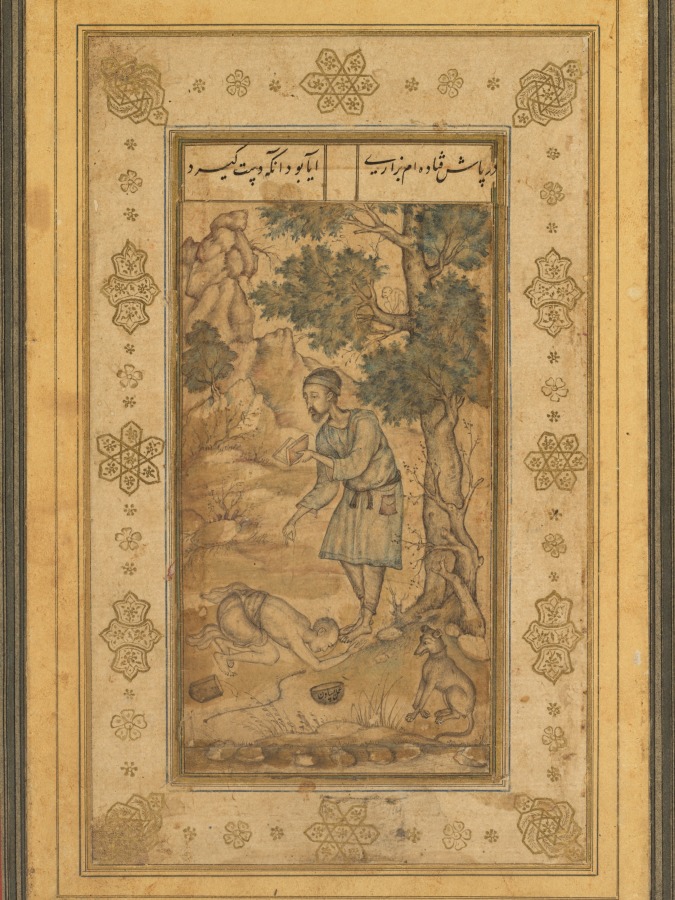
A mendicant bowing before a holy man, from the Prince Salim Album
BasavanaLinkedCulture matchlcp-055936be9a80
- Date
- c. 1585; inner border added in Allahabad c. 1602; outer border added probably 1900s
- Medium
- Gum tempera, ink, and gold on paper
- Culture
- Mughal India, court of Akbar (reigned 1556–1605)
- Department
- Indian and Southeast Asian Art
- Institution
- Cleveland Museum of Art
- Object ID
- 170789
From the Cleveland Museum of Art record
As the Mughal atelier grew into the 1580s, Indian artists become increasingly adept at incorporating Persian styles with a new dimensionality and naturalism that Akbar promoted, possibly based on his appreciation of European prints and paintings. Here, a sincere holy man wears robes tinged lightly with blue. He stands beneath a tree in the wilderness with a loyal jackal by his side. A devotee touches his head to his feet. The artist’s tiny signature is written on the alms bowl. Connoisseurs of Persian art in the Islamic world praised an artist’s virtuoso ability to work on a microscopic scale. The dog stares hungrily at the mendicant’s alms bowl, with the artist’s signature.
The authoritative record is held by Cleveland Museum of Art. LinkedCulture surfaces this object and its connections; it does not alter institutional metadata.
Get printable QR codesHide QR codes
Open QR codes for this object page and the museum record. They stay collapsed until needed.
Provenance & credit
As published by the source institution. Coverage varies — not every institution's open-data feed includes ownership history.
- Credit line
- Gift in honor of Madeline Neves Clapp; Gift of Mrs. Henry White Cannon by exchange; Bequest of Louise T. Cooper; Leonard C. Hanna Jr. Fund; From the Catherine and Ralph Benkaim Collection
- Provenance
- mid-1900s–May 1967: (Dikran Kelekian [1868–1951], New York, NY, sold to Ralph Benkaim) | 1967–2013: Catherine Glynn Benkaim and Ralph Benkaim Collection | 2013–: The Cleveland Museum of Art, Cleveland, OH
Related across collections
Semantically similar works from Cleveland Museum of Art and other institutions.