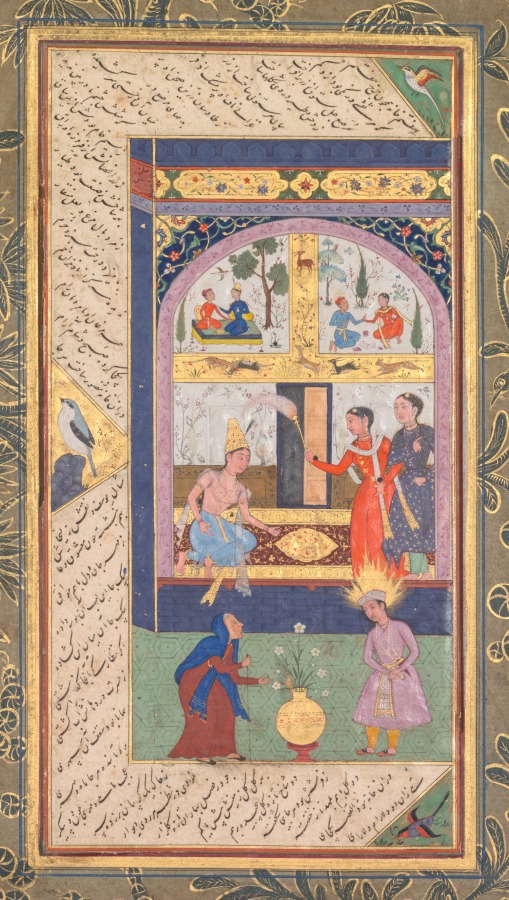
Zulaykha in her palace and as an elderly woman with Joseph (recto), from a Panj Ganj (Five Treasures) of Abd al- Rahman Jami (Persian, 1414–1492)

Cleveland Museum of Art

Zulaykha in her palace and as an elderly woman with Joseph (recto), from a Panj Ganj (Five Treasures) of Abd al- Rahman Jami (Persian, 1414–1492)

Mushfiq

Date
1603–7
Medium
Gum tempera, ink, and gold on paper
Culture
Western Afghanistan, Herat (text); Mughal India (paintings)
Department
Indian and Southeast Asian Art
Institution
Cleveland Museum of Art

The golden pot of white narcissus flowers at the bottom center of the painting signals that Zulaykha, leaning on her staff to the left, will imminently have her youth and beauty restored. In this Persian retelling of the Old Testament account from the Bible, Zulaykha lusted after Joseph, even though she was already married to Potiphar. Joseph, with the golden halo, resisted her advances until she became a widow and retained his youth, because of his extreme virtue. Above, Zulaykha as a young woman waits for Joseph in her house where murals of them as a happy couple are painted on the walls. Zulaykha is shown four times: twice in the murals, seated in the center, and below when she is much older.

The authoritative record is held by Cleveland Museum of Art. LinkedCulture surfaces this object and its connections; it does not alter institutional metadata.

Related across collections

Semantically similar works from Cleveland Museum of Art and other institutions.

Zulaykha in her palace and as an old woman with Joseph, from a Panj Ganj (Five Treasures) of Abd al-Rahman Jami (Persian, 1414–1492); verso from a Panj Ganj of Abd al-Rahman Jami (Persian, 1414–1492), with two masnavis: Yusuf va Zulaykha (Joseph and Zulaykha) and Khirad-nama-i Iskandari (Alexander’s Book of Wisdom)

Zulaykha in her palace and as an old woman with Joseph, from a Panj Ganj (Five Treasures) of Abd al-Rahman Jami (Persian, 1414–1492); verso from a Panj Ganj of Abd al-Rahman Jami (Persian, 1414–1492), with two masnavis: Yusuf va Zulaykha (Joseph and Zulaykha) and Khirad-nama-i Iskandari (Alexander’s Book of Wisdom)

Cleveland Museum of Art

Illuminated page (verso), from a Panj Ganj (Five Treasures) of Abd al- Rahman Jami (Persian, 1414–1492) with two Persian masnavis: Yusuf va Zulaykha (Joseph and Zulaykha) and Khirad-nama-i Iskandari (Alexander’s Book of Wisdom)

Illuminated page (verso), from a Panj Ganj (Five Treasures) of Abd al- Rahman Jami (Persian, 1414–1492) with two Persian masnavis: Yusuf va Zulaykha (Joseph and Zulaykha) and Khirad-nama-i Iskandari (Alexander’s Book of Wisdom)

Cleveland Museum of Art

The dream of Zulaykha, from the Amber Album

The dream of Zulaykha, from the Amber Album

Cleveland Museum of Art

Page from a Panj Ganj (Five Treasures) of Abd al-Rahman Jami (Persian, 1414–1492), with two Persian
masnavis: Yusuf va Zulaykha (Joseph and Zulaykha) and Subhat al-abrar (Rosary of the Righteous) (verso)

Page from a Panj Ganj (Five Treasures) of Abd al-Rahman Jami (Persian, 1414–1492), with two Persian masnavis: Yusuf va Zulaykha (Joseph and Zulaykha) and Subhat al-abrar (Rosary of the Righteous) (verso)

Cleveland Museum of Art

Yusuf and Zulaykha (recto); Text Page, Persian Verses (verso)

Yusuf and Zulaykha (recto); Text Page, Persian Verses (verso)

Cleveland Museum of Art

Page from the Panj Ganj (Five Treasures) of Abd al-Rahman Jami (Persian, 1414–1492), with two Persian masnavis (narrative poems): Yusuf va Zulaykha (Joseph and Zulaykha) and Subhat al-abrar (Rosary of the Righteous)

Page from the Panj Ganj (Five Treasures) of Abd al-Rahman Jami (Persian, 1414–1492), with two Persian masnavis (narrative poems): Yusuf va Zulaykha (Joseph and Zulaykha) and Subhat al-abrar (Rosary of the Righteous)

Cleveland Museum of Art

Yusuf and Zulaykha (recto), from an Anthology of Persian Verses, including The Fifth Throne from the Haft Awrang (Seven Thrones) of Jami: The Fifth Throne

Yusuf and Zulaykha (recto), from an Anthology of Persian Verses, including The Fifth Throne from the Haft Awrang (Seven Thrones) of Jami: The Fifth Throne

Cleveland Museum of Art

Yusuf and Zulaykha meeting

Yusuf and Zulaykha meeting

Cleveland Museum of Art

Lovers and beloveds: A composite of scenes from Persian, Urdu, and Sanskrit literature

Lovers and beloveds: A composite of scenes from Persian, Urdu, and Sanskrit literature

Cleveland Museum of Art

Nur Jahan holding a portrait of Emperor Jahangir

Nur Jahan holding a portrait of Emperor Jahangir

Cleveland Museum of Art

Noblewoman at a Jharokha Window Holding a Rose, from a Portraits of Women series

Noblewoman at a Jharokha Window Holding a Rose, from a Portraits of Women series

Cleveland Museum of Art

The old procuress conveys the young man’s message of love to Mansur’s wife, from a Tuti-nama (Tales of a Parrot: Seventeenth Night

The old procuress conveys the young man’s message of love to Mansur’s wife, from a Tuti-nama (Tales of a Parrot: Seventeenth Night

Cleveland Museum of Art