Cleveland Museum of Art
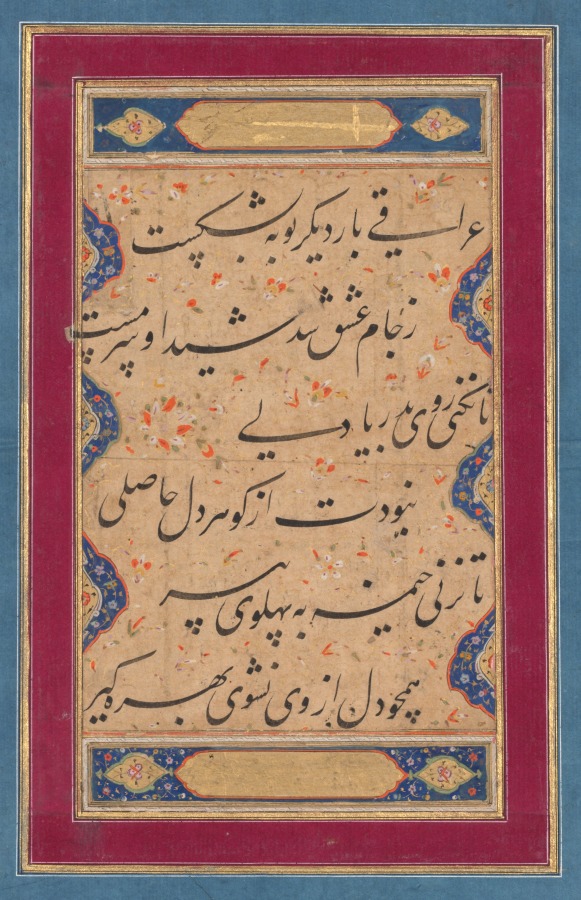
Calligraphy from a ghazal of Fakhr al-Din Iraqi (Persian, 1213–1289) and a verse from the Tuhfat al-ahrar (The Gift of the Free) of Abd al-Rahman Jami (verso)
Muhammad Rizavi HindiLinkedCulture matchlcp-b49d80e62beb
- Date
- c. 1760
- Medium
- Gum tempera, ink, and gold on paper
- Culture
- India, Mughal, 18th century
- Department
- Indian and Southeast Asian Art
- Institution
- Cleveland Museum of Art
- Object ID
- 170885
From the Cleveland Museum of Art record
The first two lines in Persian read: Once again, Iraqi broke his vows: From the cup of love he became intoxicated and ecstatic. The excerpt from the mystic poet Jami is more of a pious injunction: Until you are bold enough to take to the seas, You will not reap spiritual benefits from your inner heart. Unless you pitch your tent next to the spiritual guide, You will not enjoy him to the fullest.
The authoritative record is held by Cleveland Museum of Art. LinkedCulture surfaces this object and its connections; it does not alter institutional metadata.
Get printable QR codesHide QR codes
Open QR codes for this object page and the museum record. They stay collapsed until needed.
Provenance & credit
As published by the source institution. Coverage varies — not every institution's open-data feed includes ownership history.
- Credit line
- Gift in honor of Madeline Neves Clapp; Gift of Mrs. Henry White Cannon by exchange; Bequest of Louise T. Cooper; Leonard C. Hanna Jr. Fund; From the Catherine and Ralph Benkaim Collection
- Provenance
- ?–1849: Sir Charles Forbes, 7th Baronet [1773–1849], Bengal, London, and Scotland, by descent to his great-grandson, Colonel Sir John Forbes | ?–1962: Colonel Sir John Stewart Forbes [1901–1984], Baronet, DSO, DL, Allargue House, Strathdon, Aberdeenshire, Scotland, UK, consigned to Sotheby's London for sale | December 10, 1962: (Sotheby's, London, Western and Oriental Manuscripts and Miniatures, lot 23) | 1962–2001: Ralph Benkaim [1914–2001], Beverly Hills, CA, by descent to his wife Catherine Benkaim | 2001–2013: (Catherine Glynn Benkaim [b. 1946], Beverly Hills, CA, sold to the Cleveland Museum of Art) | 2013–: The Cleveland Museum of Art, Cleveland, OH
Related across collections
Semantically similar works from Cleveland Museum of Art and other institutions.