Cleveland Museum of Art
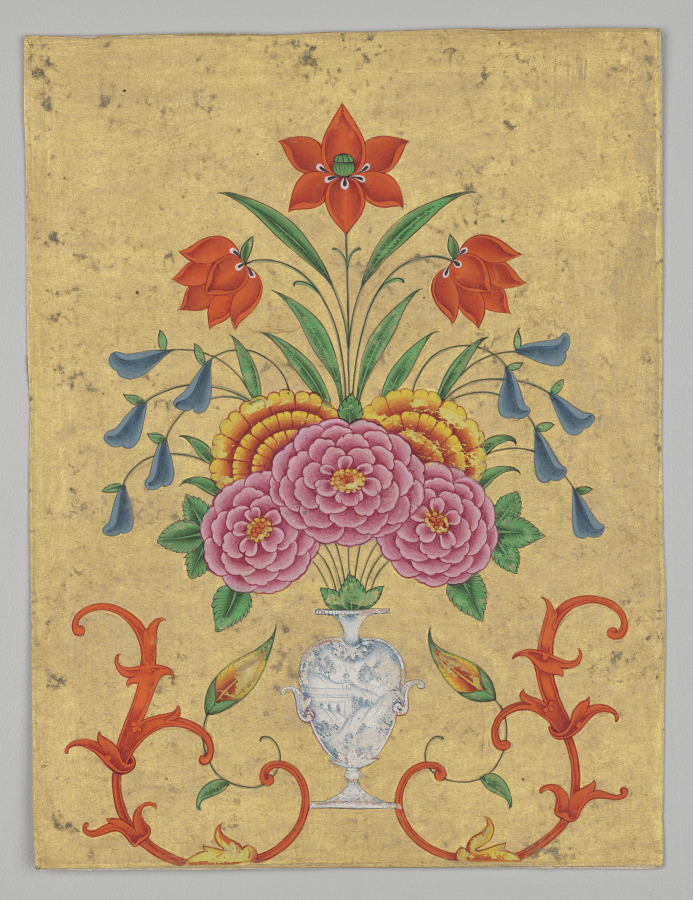
Vase with flower arrangement and scrollwork
- Date
- c. 1750–1800
- Medium
- Gum tempera and gold on paper
- Culture
- Mughal India, Lucknow
- Department
- Indian and Southeast Asian Art
- Institution
- Cleveland Museum of Art
- Object ID
- 170895
From the Cleveland Museum of Art record
The symmetry of the floral arrangement emerging from the blue-and-white porcelain vase reveals an idealized vision. The overflowing vase is among the most ancient motifs in Indian art, used to convey the concept of abundance. This image, made for an elite patron of northern India, implies the prosperity that has accrued from international connections. The vase, painted with a European-style landscape, is of the type that was made in China for export to Europe. The scrolling ornament on either side may be ultimately derived from Persian motifs, but reworked into a European style, painted by Indian artists. The blue bell-shaped flowers may be neelakurinji, which bloom once every twelve years.
The authoritative record is held by Cleveland Museum of Art. LinkedCulture surfaces this object and its connections; it does not alter institutional metadata.
Get printable QR codesHide QR codes
Open QR codes for this object page and the museum record. They stay collapsed until needed.
Provenance & credit
As published by the source institution. Coverage varies — not every institution's open-data feed includes ownership history.
- Credit line
- Gift in honor of Madeline Neves Clapp; Gift of Mrs. Henry White Cannon by exchange; Bequest of Louise T. Cooper; Leonard C. Hanna Jr. Fund; From the Catherine and Ralph Benkaim Collection
- Provenance
- December 9, 1980: (Sotheby Park Bernet, New York, NY, Fine Oriental Miniatures, Manuscripts and Works of Art, 9 December 1980, lot 28) | ?–2002: (Sam Fogg, London, England, sold to Catherine Glynn Benkaim) | 2002–2013: (Catherine Glynn Benkaim [b. 1946], Beverly Hills, CA, sold to the Cleveland Museum of Art) | 2013–: The Cleveland Museum of Art, Cleveland, OH
Related across collections
Semantically similar works from Cleveland Museum of Art and other institutions.