Cleveland Museum of Art
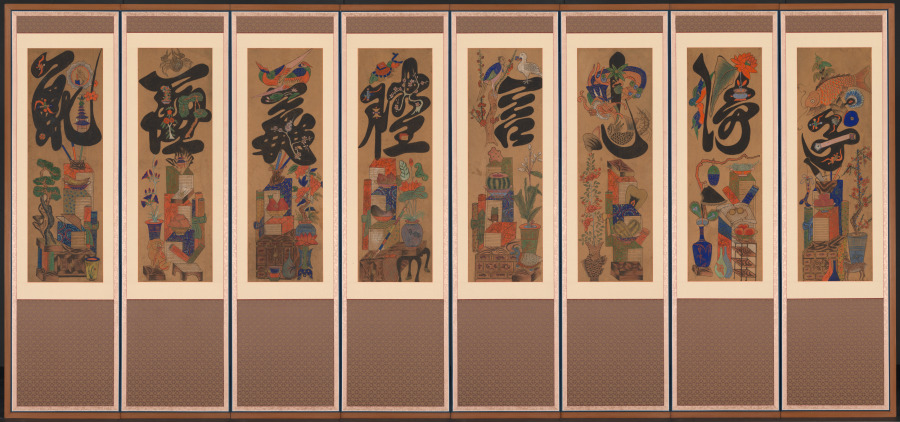
Munja-Chaekgeori Screen (Character-Books Screen)
- Date
- early 1900s
- Medium
- Eight-panel folding screen, ink on paper
- Culture
- Korea, Joseon dynasty (1392–1910)
- Department
- Korean Art
- Institution
- Cleveland Museum of Art
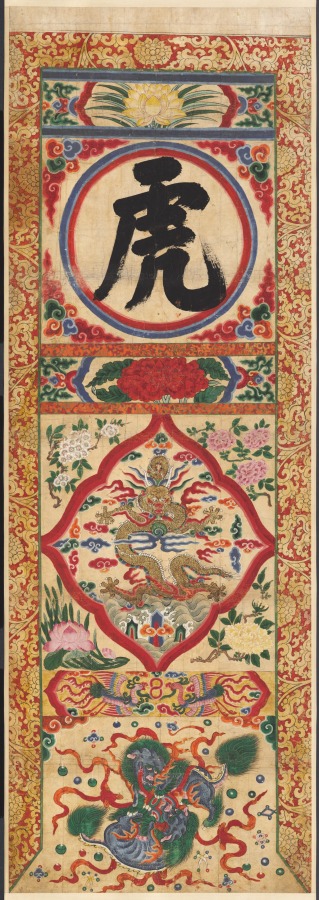
This folding screen is a whimsical harmony of two different subjects: chaekgeori , or books and things; and munja , or characters. The lower section of each panel depicts the imagery of things, including books, decorative arts, and utilitarian objects. The upper portion of each panel bears a classical Chinese character. Read from far right to left, the eight characters refer to the values of Confucian teachings of the Joseon dynasty: filial piety, brotherly love, loyalty, trust, propriety, righteousness, modesty, and humility. While these two pictorial genres are harmoniously conjoined on the same picture plane, two sharply contrasting world views—urban consumerism and traditional Confucian ethics that despise materialism—compete with one another. The eight Korean characters each mean filial piety, brotherly love, loyalty, trust, propriety, righteousness or justice, modesty or integrity, and humility or the feeling of shame.
The authoritative record is held by Cleveland Museum of Art. LinkedCulture surfaces this object and its connections; it does not alter institutional metadata.
Related across collections
Semantically similar works from Cleveland Museum of Art and other institutions.

Books and Scholar’s Objects (Chaekgeori)
Minneapolis Institute of Art
Books and Scholars’ Accoutrements
Cleveland Museum of Art
![Chang'an [left of a pair]](https://0.api.artsmia.org/800/117747.jpg)
Chang'an [left of a pair]
Minneapolis Institute of Art
![Chang'an [right of a pair]](https://6.api.artsmia.org/800/117746.jpg)
Chang'an [right of a pair]
Minneapolis Institute of Art
Illustrated Guide to the Exemplars of the Five Relationships of Confucianism (O-ryun Haeng-sil To), Volumes 4 and 5: Brothers and Friends
Harvard Art Museums
![Scenes from The Tale of Genji [left of a pair]](https://2.api.artsmia.org/800/122089.jpg)
Scenes from The Tale of Genji [left of a pair]
Minneapolis Institute of Art
Painting of One Hundred Themes
Cleveland Museum of Art
![Scenes from The Tale of Genji [right of a pair]](https://3.api.artsmia.org/800/122090.jpg)
Scenes from The Tale of Genji [right of a pair]
Minneapolis Institute of Art
Painted Panel of Character "Dragon"
Cleveland Museum of Art
Illustrated Guide to the Exemplars of the Five Relationships of Confucianism (O-ryun Haeng-sil To), Volume 1: Filial Sons
Harvard Art Museums
Set of Four Painted Characters
Cleveland Museum of Art
Buddhist Deities
Cleveland Museum of Art