Cleveland Museum of Art
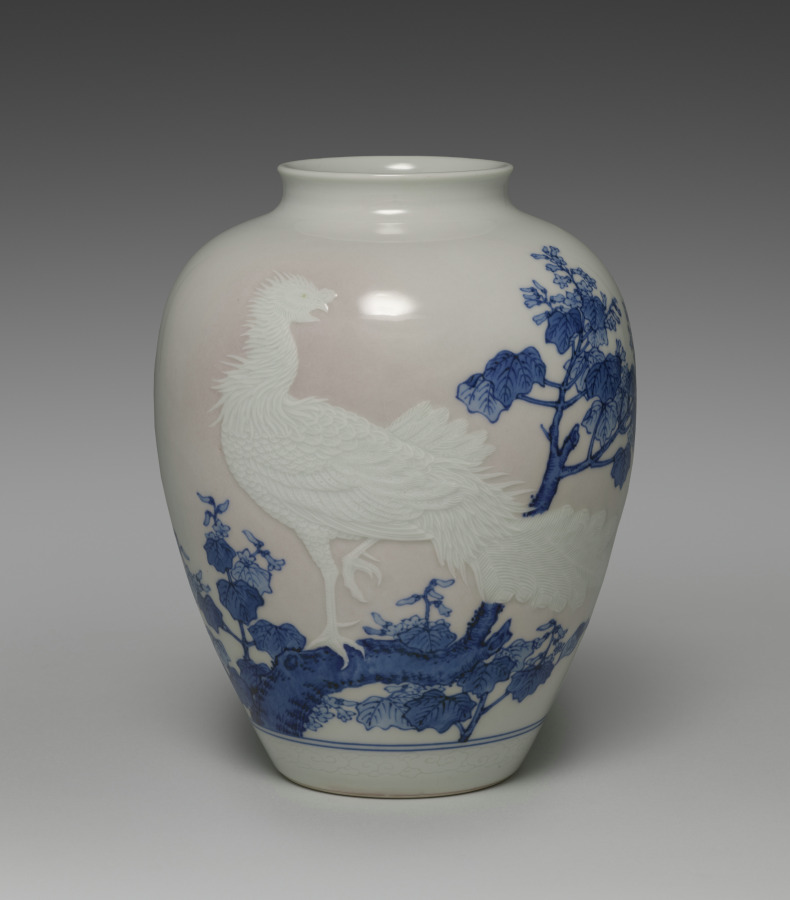
Flower Vase with Phoenix in Paulownia
Seifū Yohei IIILinkedCulture matchlcp-76f8f3f7462b
- Date
- 1897–1914
- Medium
- Porcelain with molded and carved design and underglaze color
- Culture
- Japan, Meiji period (1868–1912)
- Department
- Japanese Art
- Institution
- Cleveland Museum of Art
- Object ID
- 299431
What the image shows
A blue and white porcelain vase with a relief design of a peacock on a branch.
Generated by LinkedCulture from the photograph alone, without the museum’s catalogue text (Qwen/Qwen2.5-VL-7B-Instruct), and not yet reviewed by a person. It describes the picture, not the object’s history, and it is not part of the museum’s record.
From the Cleveland Museum of Art record
The phoenix’s commanding presence on this vase was created by adding clay to the surface of the white clay body and then intricately molding and carving it. Then cobalt blue was used to paint the paulownia tree upon which the phoenix perches. Yohei III used a masking technique, covering the phoenix with paper before adding pink color to the area surrounding it. Firing with an allover transparent glaze created a glossy surface, with the phoenix standing out boldly from the background. The mythical bird’s long tail sweeps majestically around the vessel so that one must move around it to see the eyespots in its plumes. A symbol of imperial power in both China and Japan, the phoenix is said to alight only in the paulownia tree. Upon close inspection of its face, one can see that the phoenix’s eye is in yellow under the glaze. The scene is set off at the bottom with a double band of underglaze blue above an incised ring of cloud. Once Yohei III had created his creamy translucent taihakuji glaze, he began applying it over the entire surface of an ivory clay body with motifs in low relief to achieve a creamy white-on-white design. He then began using the combination of gradated pink around raised motifs on a typical white porcelain clay body like the one for this vase. He masked his low-relief designs with paper before sprinkling diluted iron oxide glaze onto the surrounding areas through a net with a brush. These unpigmented elements stand out as starkly white against the gentle pink blush color that surrounds them. Still later, he added pink to the translucent creamy glaze he used in kanpakuji works and used it over motifs in relief on an ivory clay body for an overall pink-tinged cream effect (see CMA 2022.198 ). In 1893, Seifū Yohei III became the first ceramist to be appointed as an Imperial Household Artist under a system introduced by the Japanese government in 1890.
The authoritative record is held by Cleveland Museum of Art. LinkedCulture surfaces this object and its connections; it does not alter institutional metadata.
Get printable QR codesHide QR codes
Open QR codes for this object page and the museum record. They stay collapsed until needed.
Provenance & credit
As published by the source institution. Coverage varies — not every institution's open-data feed includes ownership history.
- Credit line
- Gift of James and Christine Heusinger
- Provenance
- ?–2022: James and Christine Heusinger, Berea, OH, given to the Cleveland Museum of Art | 2022–: The Cleveland Museum of Art, Cleveland, OH
Related across collections
Semantically similar works from Cleveland Museum of Art and other institutions.