Cleveland Museum of Art
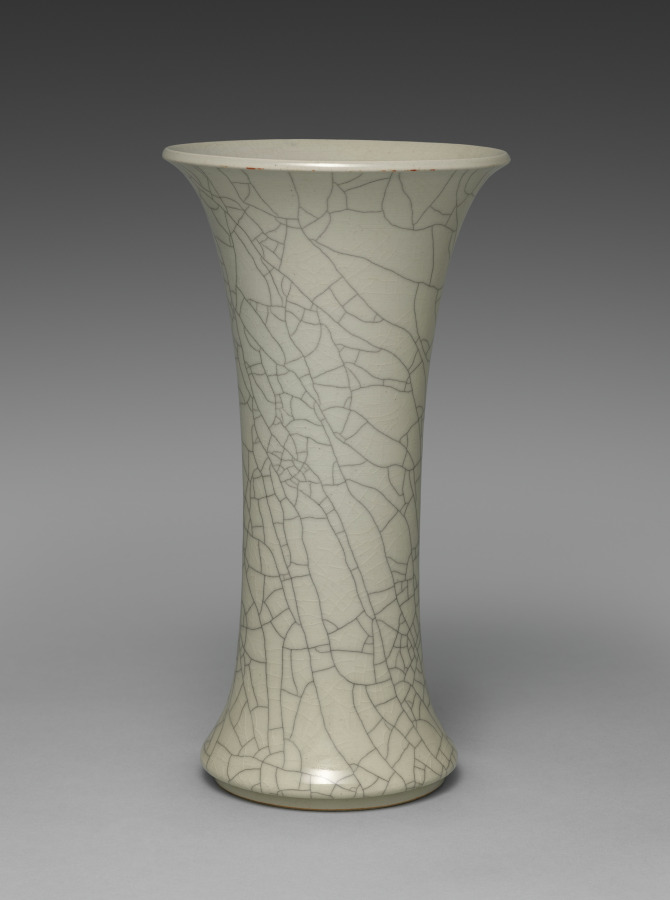
Gu-shaped Vase
Seifū Yohei IIILinkedCulture matchlcp-76f8f3f7462b
- Date
- 1912–14
- Medium
- Porcelain with crackled glaze
- Culture
- Japan, Meiji period (1868–1912)
- Department
- Japanese Art
- Institution
- Cleveland Museum of Art
- Object ID
- 299439
What the image shows
A tall, slender vase with a crackled glaze.
Generated by LinkedCulture from the photograph alone, without the museum’s catalogue text (Qwen/Qwen2.5-VL-7B-Instruct), and not yet reviewed by a person. It describes the picture, not the object’s history, and it is not part of the museum’s record.
From the Cleveland Museum of Art record
Seifū Yohei III mined the repertoire of Chinese vessel types, from ceramics modeled after ancient ritual bronzes to shapes developed in the Yuan (1279–1368) and Ming (1368–1644) dynasties. His designs tended to be formal and restrained, often featuring creamy white glazes suggestive of the hue of Ding ware and green glazes resembling Longquan ware. This gu -shaped vase has a cracked-ice glaze, which was once customarily called Ge (Japanese pronunciation Ka ), after the kiln where it purportedly originated during the Southern Song dynasty (1127–1279). The glaze’s double-crackle pattern, featuring both deeper and shallower cracks, is called “gold threads and iron lines.” The effect was enhanced here by coating the vessel with ink or another stain, which was allowed to seep into the cracks before the surface was wiped clean. Gu -shaped vases are relatively slender cylinders that flare at both the mouth and foot with orbs or drumlike forms partway up the vessel.
The authoritative record is held by Cleveland Museum of Art. LinkedCulture surfaces this object and its connections; it does not alter institutional metadata.
Get printable QR codesHide QR codes
Open QR codes for this object page and the museum record. They stay collapsed until needed.
Provenance & credit
As published by the source institution. Coverage varies — not every institution's open-data feed includes ownership history.
- Credit line
- Gift of James and Christine Heusinger
- Provenance
- ?–2022: James and Christine Heusinger, Berea, OH, given to the Cleveland Museum of Art | 2022–: The Cleveland Museum of Art, Cleveland, OH
Related across collections
Semantically similar works from Cleveland Museum of Art and other institutions.