Cleveland Museum of Art
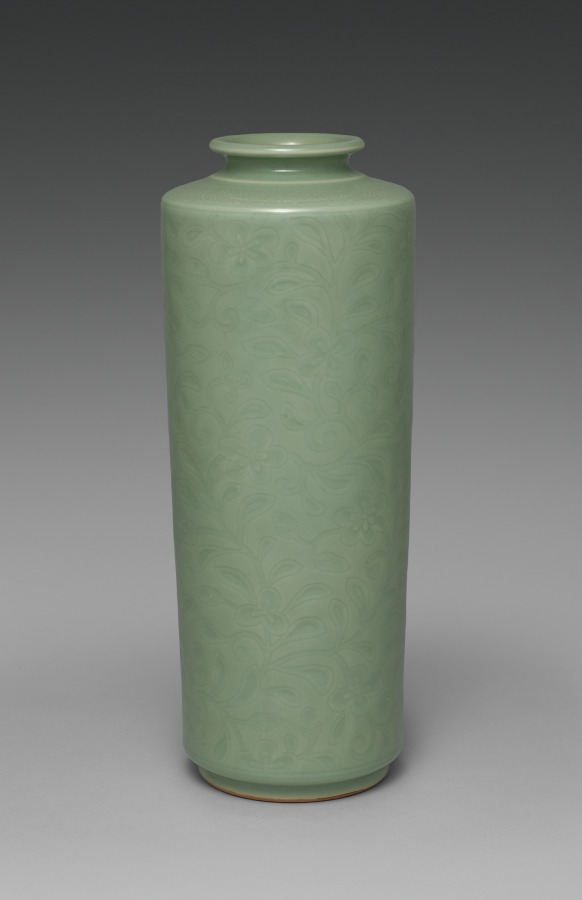
Tong-Shaped Vase with Flowers and Grasses
Seifū Yohei IVLinkedCulture matchlcp-8011e1c8592a
- Date
- 1914–46
- Medium
- Porcelain with molded and carved design and green glaze
- Culture
- Japan, Taishō period (1912–26) or Shōwa period (1926–89)
- Department
- Japanese Art
- Institution
- Cleveland Museum of Art
- Object ID
- 299446
What the image shows
A tall, cylindrical vase with a light green glaze and floral embossing.
Generated by LinkedCulture from the photograph alone, without the museum’s catalogue text (Qwen/Qwen2.5-VL-7B-Instruct), and not yet reviewed by a person. It describes the picture, not the object’s history, and it is not part of the museum’s record.
From the Cleveland Museum of Art record
Many of the vases created by Yohei III and IV were made with reference to and in emulation of Chinese ceramics in both form and glazing. The vessel type called tongping , pronounced tōbin in Japanese, is tall and cylindrical, like the thick length of bamboo referenced in the shape of the ideograph tong 筒. Unlike the ancient gu , hu , and guan , this form did not emerge in China until the Ming dynasty, and many such vases date to the early Qing dynasty. Two green-glazed vases, CMA 2022.225 by Yohei III and this one by Yohei IV, are interpretations of this form. Yohei III’s version has slightly hunched shoulders and is somewhat wider at the top below the small neck and lip. Yohei IV’s vase is more angular. The wide rack of molded cloud encircling the Yohei III vase rises subtly from very low relief banding above and below it, accentuating the vessel’s rounded edges and complementing the form. In contrast, the allover flower vine pattern on the body and “seven treasures” pattern at the collar of the vase by Yohei IV evokes a garment’s cuffed sleeve, like the common English appellation for this type of vessel—“sleeve vase.” Seifū Yohei IV continued to create works in the studio’s signature colors but also produced pieces with strong color and flare that were his interpretations of Qing dynasty (1644–1911) glazes.
The authoritative record is held by Cleveland Museum of Art. LinkedCulture surfaces this object and its connections; it does not alter institutional metadata.
Get printable QR codesHide QR codes
Open QR codes for this object page and the museum record. They stay collapsed until needed.
Provenance & credit
As published by the source institution. Coverage varies — not every institution's open-data feed includes ownership history.
- Credit line
- Gift of James and Christine Heusinger
- Provenance
- ?–2022: James and Christine Heusinger, Berea, OH, given to the Cleveland Museum of Art | 2022–: The Cleveland Museum of Art, Cleveland, OH
Related across collections
Semantically similar works from Cleveland Museum of Art and other institutions.