Cleveland Museum of Art
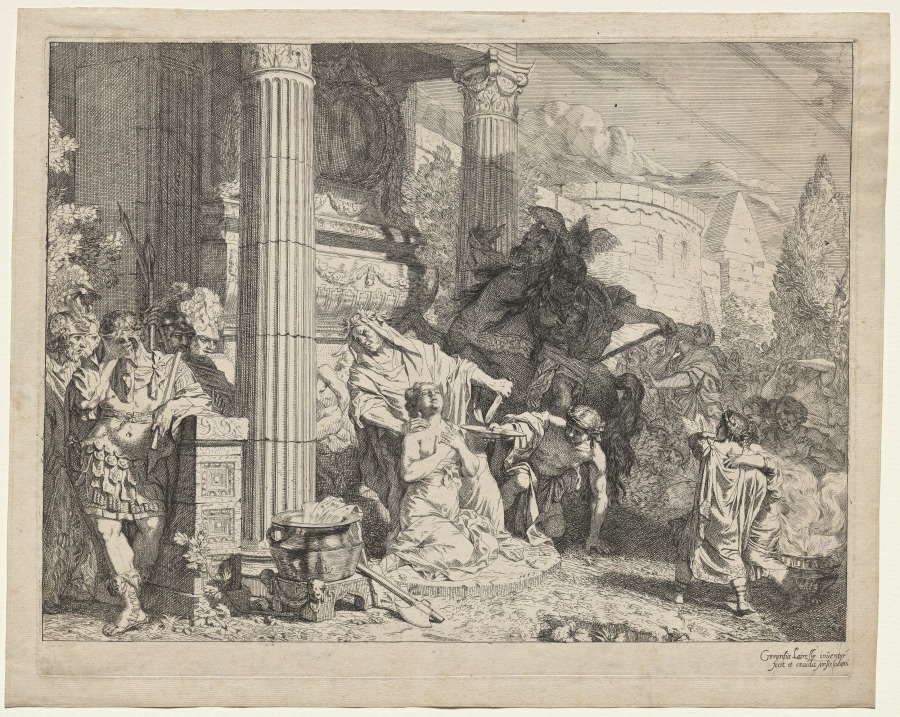
The Sacrifice of Polyxena
Gerard de LairesseLinkedCulture matchlcp-52b63bfbfcaa
- Date
- 1667
- Medium
- etching
- Culture
- Netherlands
- Department
- Prints
- Institution
- Cleveland Museum of Art
- Object ID
- 446714
From the Cleveland Museum of Art record
After the fall of Troy, the Trojan women were divided among the Greeks. Achilles arose from his grave and demanded that Polyxena, the daughter of King Priam and Queen Hecuba, be slain on his tomb in order to join him in the afterlife. Behind a blindfolded Polyxena who awaits her fate on a sacrificial altar in this image, Achilles appears in warrior’s garb on a rearing horse. Gerard De Lairesse’s figures are firmly modeled, and the space clearly defined with classical architecture, and reflect his interest in French art of the same period. Gerard de Lairesse was called the “Dutch Poussin” for his role in bringing a French artistic style to the Netherlands in the late 1600s.
The authoritative record is held by Cleveland Museum of Art. LinkedCulture surfaces this object and its connections; it does not alter institutional metadata.
Get printable QR codesHide QR codes
Open QR codes for this object page and the museum record. They stay collapsed until needed.
Provenance & credit
As published by the source institution. Coverage varies — not every institution's open-data feed includes ownership history.
- Credit line
- L. E. Holden Fund
- Provenance
- ?-2021: James Bergquist, Boston, MA, sold to The Cleveland Museum of Art | December 6, 2021-: The Cleveland Museum of Art, Cleveland, OH
Related across collections
Semantically similar works from Cleveland Museum of Art and other institutions.