Cleveland Museum of Art
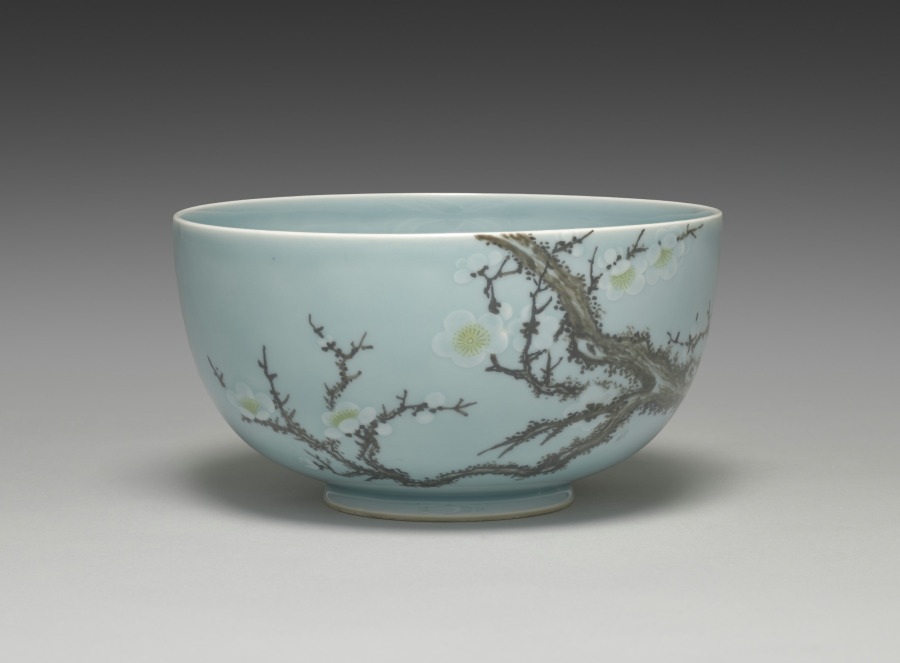
Sweets Bowl with Plum Tree
Seifū Yohei IVLinkedCulture matchlcp-8011e1c8592a
- Date
- 1914–46
- Medium
- Porcelain with underglaze color and modeled design
- Culture
- Japan, Taishō period (1912–26) to Shōwa period (1926–89)
- Department
- Japanese Art
- Institution
- Cleveland Museum of Art
- Object ID
- 447713
What the image shows
A light blue bowl with a painted branch and blossoms.
Generated by LinkedCulture from the photograph alone, without the museum’s catalogue text (Qwen/Qwen2.5-VL-7B-Instruct), and not yet reviewed by a person. It describes the picture, not the object’s history, and it is not part of the museum’s record.
From the Cleveland Museum of Art record
In Chinese culture, the plum symbolizes the virtue of perseverance. For his sweets bowl based on Qing dynasty (1644–1911) Chinese prototypes, Seifū Yohei IV first painted the gnarled boughs of a plum tree in iron oxide on the surface. Then he made the tree’s blossoms slightly raised by building up slip, or liquified clay. He painted their centers yellow. Before applying the blue glaze, he covered the blossoms with paper so that they remained white. Broad access to high-quality Chinese ceramics occasioned by the collapse of the Qing dynasty (1644–1911) and the dispersal of elite Chinese collections presented Seifū Yohei IV with models for both molded decoration and painted motifs.
The authoritative record is held by Cleveland Museum of Art. LinkedCulture surfaces this object and its connections; it does not alter institutional metadata.
Get printable QR codesHide QR codes
Open QR codes for this object page and the museum record. They stay collapsed until needed.
Provenance & credit
As published by the source institution. Coverage varies — not every institution's open-data feed includes ownership history.
- Credit line
- Gift of James and Christine Heusinger
- Provenance
- ?–2022: James and Christine Heusinger, Berea, OH, given to the Cleveland Museum of Art | 2022–: The Cleveland Museum of Art, Cleveland, OH
Related across collections
Semantically similar works from Cleveland Museum of Art and other institutions.