Cleveland Museum of Art
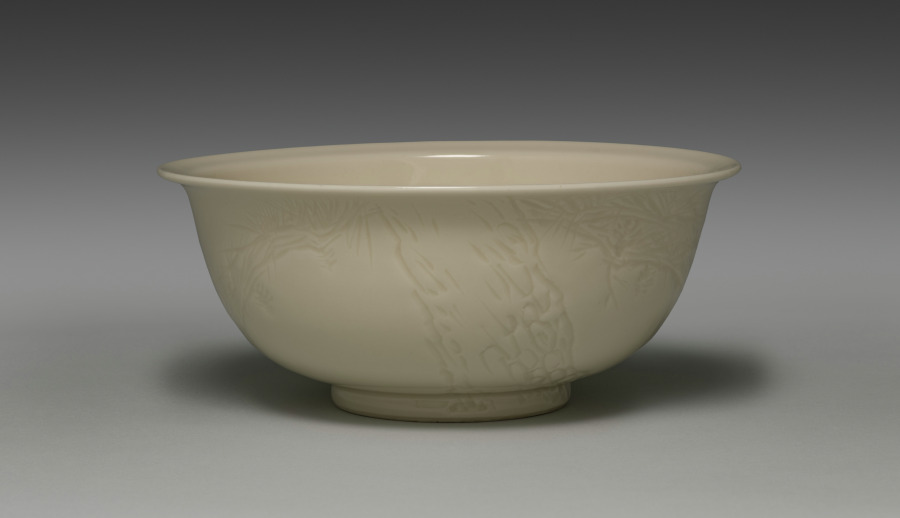
Bowl with Old Pine and Poem
Seifū Yohei IVLinkedCulture matchlcp-8011e1c8592a
- Date
- 1914–46
- Medium
- Porcelain with molded and carved design
- Culture
- Japan, Taishō period (1912–26) or Shōwa period (1926–89)
- Department
- Japanese Art
- Institution
- Cleveland Museum of Art
- Object ID
- 447807
What the image shows
A cream-colored bowl with subtle floral patterns sits on a neutral background.
Generated by LinkedCulture from the photograph alone, without the museum’s catalogue text (Qwen/Qwen2.5-VL-7B-Instruct), and not yet reviewed by a person. It describes the picture, not the object’s history, and it is not part of the museum’s record.
From the Cleveland Museum of Art record
A grand, aged pine is carved into the body of this bowl. The inscription on the reverse side explains the tree’s presence. It is an altered version of two lines from a poem by Li Jiao (646?–715?) called “Pine.” Li Jiao was a senior government official who had a tumultuous career under the reign of Wu Zetian (r. 690–705), as well as those of her sons and grandson during the Tang dynasty (618–907). Although little known today, his work was read in Japan during the Heian (794–1185) and Kamakura periods (1185–1333). An anthology containing his poems, which was lost in China, was passed down across the generations in Japan. The translation of the inscription is as follows (the original characters, written and read from right to left, are shown below from left to right): The crane nests in the mastwood tree, the wind flicks at its peaceful branches. 鶴樹君子風拂太平枝 The mastwood is a pine-like evergreen, and the crane sheltering there is protected from the wind. In the original poem, the characters before “branches” (枝) are rather 大夫, meaning “high official.” This is likely a reference to the title bestowed upon a pine tree by the emperor Qin Shi Huang (r. 221–210 BCE) in thanks for its protection when a fierce rain fell as he ascended Mount Tai to pay his obeisance to the heavens. The box inscription identifies the bowl's glaze as kanpakuyū , "bright-jewel white glaze."
The authoritative record is held by Cleveland Museum of Art. LinkedCulture surfaces this object and its connections; it does not alter institutional metadata.
Get printable QR codesHide QR codes
Open QR codes for this object page and the museum record. They stay collapsed until needed.
Provenance & credit
As published by the source institution. Coverage varies — not every institution's open-data feed includes ownership history.
- Credit line
- Gift of James and Christine Heusinger
- Provenance
- ?–2022: James and Christine Heusinger, Berea, OH, given to the Cleveland Museum of Art | 2022–: The Cleveland Museum of Art, Cleveland, OH
Related across collections
Semantically similar works from Cleveland Museum of Art and other institutions.