Cleveland Museum of Art
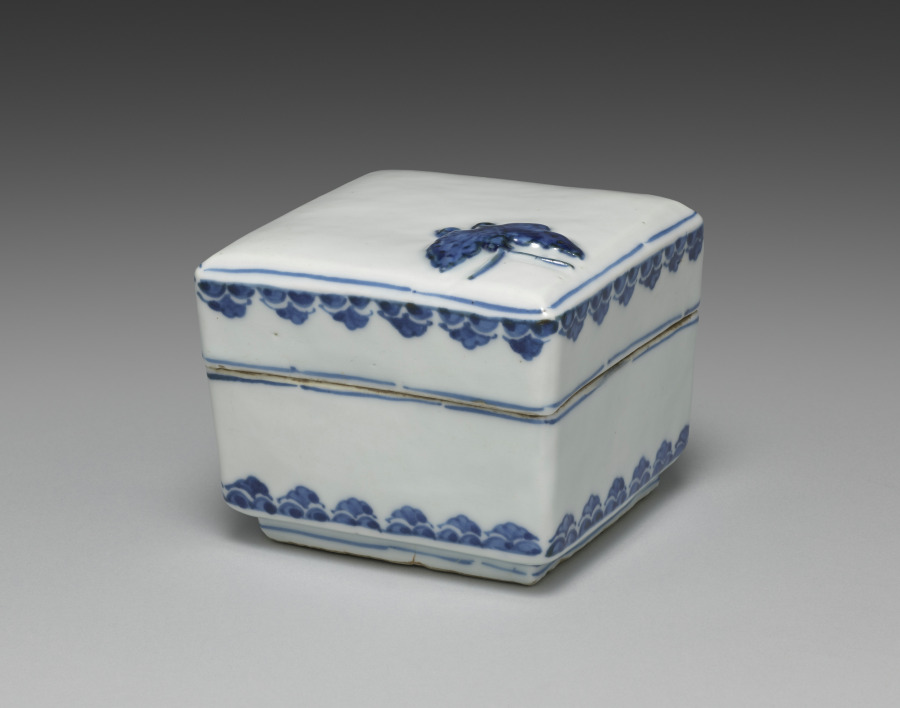
Box with Butterfly
Seifū Yohei ILinkedCulture matchlcp-a50cb2e844c7
- Date
- 1855–57
- Medium
- Porcelain with underglaze blue
- Culture
- Japan, Meiji period (1868–1912)
- Department
- Japanese Art
- Institution
- Cleveland Museum of Art
- Object ID
- 447828
From the Cleveland Museum of Art record
This sturdy box, with comparatively thick walls and resulting heft, is sparsely decorated with a single butterfly motif in dark underglaze blue cobalt in one corner of the lid and with repeating floral patterns along the lid and base. Single broken lines of underglaze blue define the edge of the box lid’s top where it curves to meet the sides and again where it meets the base of the box. Another blue band runs around the upper rim of the base where it meets the lip, left unglazed for a better grip of the lid when the box is closed. Yohei I’s signature on the center of the recessed base is set within a wide blue square. The porcelain box is meant to call to mind a famous story attributed to Zhuang Zhou (c. 369–286 BCE), also known as Master Zhuang, or Zhuangzi, pronounced Soji in Japanese. The second chapter of Zhuangzi , his eponymous collection of anecdotes, records the story as follows: Once, Zhuang Zhou dreamt he was a butterfly, a butterfly flitting and fluttering about, happy with himself and doing as he pleased. He didn’t know that he was Zhuang Zhou. Suddenly, he woke up and there he was, solid and unmistakable Zhuang Zhou. But he didn’t know if he was Zhuang Zhou who had dreamt he was a butterfly, or a butterfly dreaming that he was Zhuang Zhou. Between Zhuang Zhou and the butterfly there must be some distinction! This is called the Transformation of Things. The lidded box resembles kosometsuke , the porcelains in underglaze blue made to order or on speculation for the Japanese market during the early to mid-1600s in Jingdezhen, China. These works were often made from designs submitted by Japanese clients, many of whom were masters of chanoyu , who sought the wares for their tea practice. The relative roughness of the clay and the distortions in the fired object were intentional, as they created the rustic effect desired by Japanese tea communities. It is possible that the model for this box was a smaller lidded box meant for storing incense.
The authoritative record is held by Cleveland Museum of Art. LinkedCulture surfaces this object and its connections; it does not alter institutional metadata.
Get printable QR codesHide QR codes
Open QR codes for this object page and the museum record. They stay collapsed until needed.
Provenance & credit
As published by the source institution. Coverage varies — not every institution's open-data feed includes ownership history.
- Credit line
- Gift of James and Christine Heusinger
- Provenance
- ?–2022: James and Christine Heusinger, Berea, OH, given to the Cleveland Museum of Art | 2022–: The Cleveland Museum of Art, Cleveland, OH
Related across collections
Semantically similar works from Cleveland Museum of Art and other institutions.