Cleveland Museum of Art
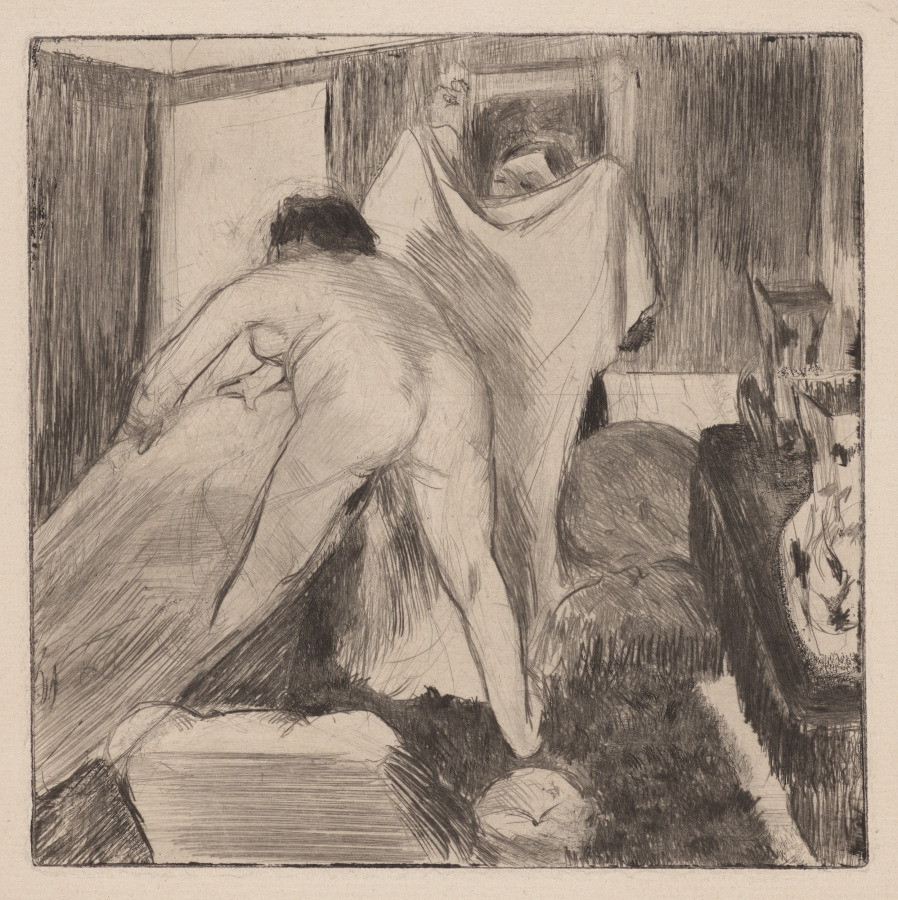
Leaving the Bath
Edgar DegasLinkedCulture matchlcp-568c79847d76
- Date
- 1879–80
- Medium
- drypoint, aquatint
- Culture
- France
- Department
- Prints
- Institution
- Cleveland Museum of Art
- Object ID
- 701493
From the Cleveland Museum of Art record
In Leaving the Bath , a woman is seen from behind as she awkwardly grips a tub while cautiously stepping out of it. Nearby, a maid is mostly obscured by a cloth meant to dry and warm her. Their sketchlike surroundings communicate intimacy and privacy and, in what would become a characteristic aspect of his bather imagery, Edgar Degas places the viewer in a voyeuristic perspective, with the two women unaware of our presence. The artist began to explore etching in the 1850s, registering in the print department of Paris’s Bibliothèque Nationale so that he could closely study the works of past masters such as Rembrandt van Rijn. Degas saw prints as having an important part to play in the Impressionists’ group exhibitions and displayed them alongside paintings there. Edgar Degas created this print by drawing on a copper plate, not with a traditional etching needle, but with a copper rod—a component of early electric lamps. This nontraditional tool produced an effect that Degas appreciated, and he experimented further after bringing the plate home by working on it with materials ranging from an emery pencil to a stone.
The authoritative record is held by Cleveland Museum of Art. LinkedCulture surfaces this object and its connections; it does not alter institutional metadata.
Get printable QR codesHide QR codes
Open QR codes for this object page and the museum record. They stay collapsed until needed.
Provenance & credit
As published by the source institution. Coverage varies — not every institution's open-data feed includes ownership history.
- Credit line
- Alma Kroeger Fund
- Provenance
- Estate of Edgar Degas (Lugt 657) | 1918: his posthumous sale, Paris (experts Delteil, Bernheim-Jeune, Durand-Ruel, Vollard), 22 November 1918, lot 96. | 1987: Galerie Kornfeld, Berne, Switzerland, 17 June 1987, lot 33 | Collection of Samuel Josefowitz | September 25, 2025: (Christie's, London, sold to The Cleveland Museum of Art, Cleveland, OH) | December 1, 2025–: The Cleveland Museum of Art, Cleveland, OH
Related across collections
Semantically similar works from Cleveland Museum of Art and other institutions.