Cleveland Museum of Art
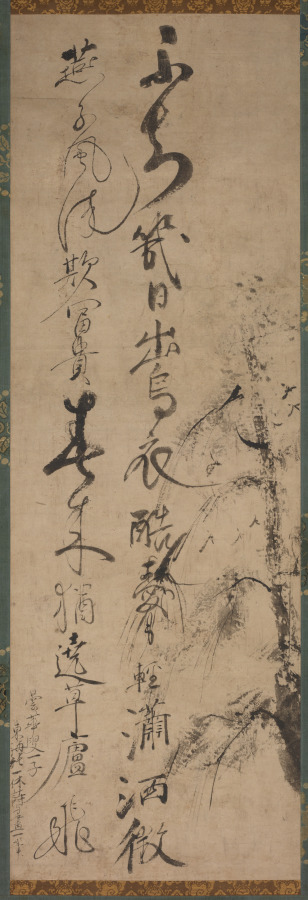
Calligraphy with Willow and Swallows
Ikkyū SōjunLinkedCulture matchlcp-124e70d14c6f
- Date
- 1400s
- Medium
- hanging scroll, ink on paper
- Culture
- Japan, Muromachi period (1392–1573)
- Department
- Japanese Art
- Institution
- Cleveland Museum of Art
- Object ID
- 90151
From the Cleveland Museum of Art record
The famed Buddhist monk Ikkyū is best remembered for his calligraphy. Calligraphic conventions of his time called for brushwork that did not vary much in style from character to character. However, as Ikkyū’s lines progress, his brushwork wanders between standard script and a sort of shorthand, marked by an uneven distribution of ink and a reduction of the characters to only the most necessary strokes. Ikkyū’s direct communication of emotion via brushwork became characteristic of the works produced by monks affiliated with the temple Daitokuji later in the Edo period (1615–1868).
The authoritative record is held by Cleveland Museum of Art. LinkedCulture surfaces this object and its connections; it does not alter institutional metadata.
Get printable QR codesHide QR codes
Open QR codes for this object page and the museum record. They stay collapsed until needed.
Provenance & credit
As published by the source institution. Coverage varies — not every institution's open-data feed includes ownership history.
- Credit line
- Gift from the Collection of George Gund III
- Provenance
- ?-2015: George Gund III [1937-2013], bequest to the Cleveland Museum of Art | 2015-: The Cleveland Museum of Art, Cleveland, OH
Related across collections
Semantically similar works from Cleveland Museum of Art and other institutions.