Cleveland Museum of Art
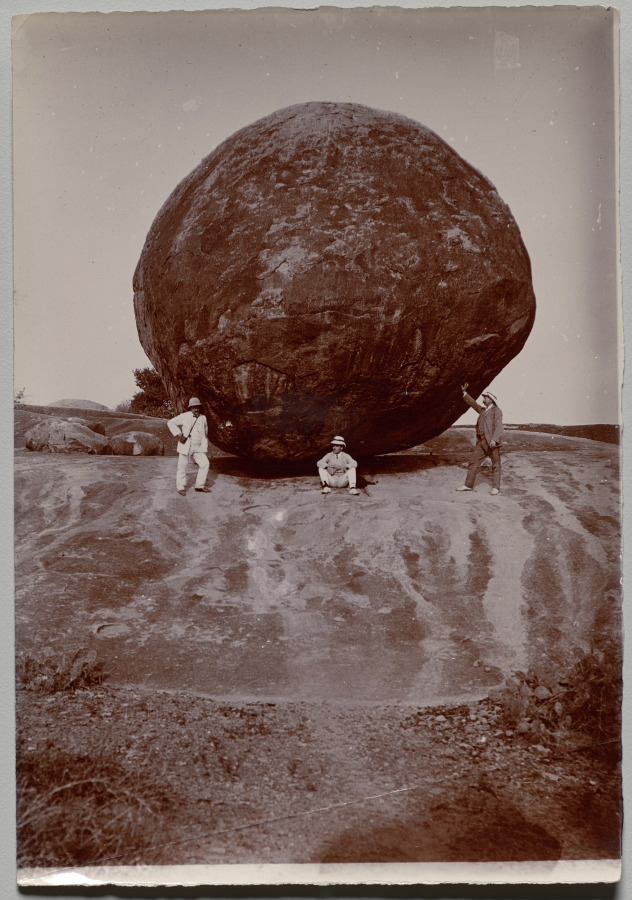
Krishna's Butter Ball, Mahabalipuram
Unidentified PhotographerLinkedCulture matchlcp-49f91d887123
- Date
- c. 1900s
- Medium
- Gelatin silver print, toned, on collodion printing-out paper
- Culture
- early 20th century
- Department
- Photography
- Institution
- Cleveland Museum of Art
- Object ID
- 92759
From the Cleveland Museum of Art record
Mahabalipuram is a site on India’s southeastern coast where numerous rock-cut temples and sculptures were carved during the early 600s. The site includes a remarkable, naturally occurring boulder that became known popularly as Krishna’s Butter Ball, thereby merging a geological phenomenon with sacred narrative. If baby Krishna could crawl while holding this monolith as effortlessly in his hand as a ball of butter, he must be a magnificently powerful god. Colonial-era tourists enjoy their excursion to the site with no indication that they recognized its sanctity. Photographs such as this would have been sent back to Britain for viewers to marvel at the landscape of India. It was popular during the early 1900s to tone silver gelatin photographs with gold to give them a warm glow.
The authoritative record is held by Cleveland Museum of Art. LinkedCulture surfaces this object and its connections; it does not alter institutional metadata.
Get printable QR codesHide QR codes
Open QR codes for this object page and the museum record. They stay collapsed until needed.
Provenance & credit
As published by the source institution. Coverage varies — not every institution's open-data feed includes ownership history.
- Credit line
- Gift of Barbara Tannenbaum and Mark Soppeland
- Provenance
- ?–2015: (Pump Park Vintage Photography, Ltd., Downpatrick, United Kingdom) | 2015–2019: Barbara L. Tannenbaum, Beachwood, OH, given to the Cleveland Museum of Art | March 4, 2019–: The Cleveland Museum of Art, Cleveland, OH
Related across collections
Semantically similar works from Cleveland Museum of Art and other institutions.