Cleveland Museum of Art
Upper Paneling from a Sacristy Armoire
Giuliano da MaianoLinkedCulture matchlcp-fbbe6785d16e
- Date
- c. 1460–1475
- Medium
- walnut, inlaid with holly and ebony
- Culture
- Italy, Florence
- Department
- Medieval Art
- Institution
- Cleveland Museum of Art
- Object ID
- 94965
From the Cleveland Museum of Art record
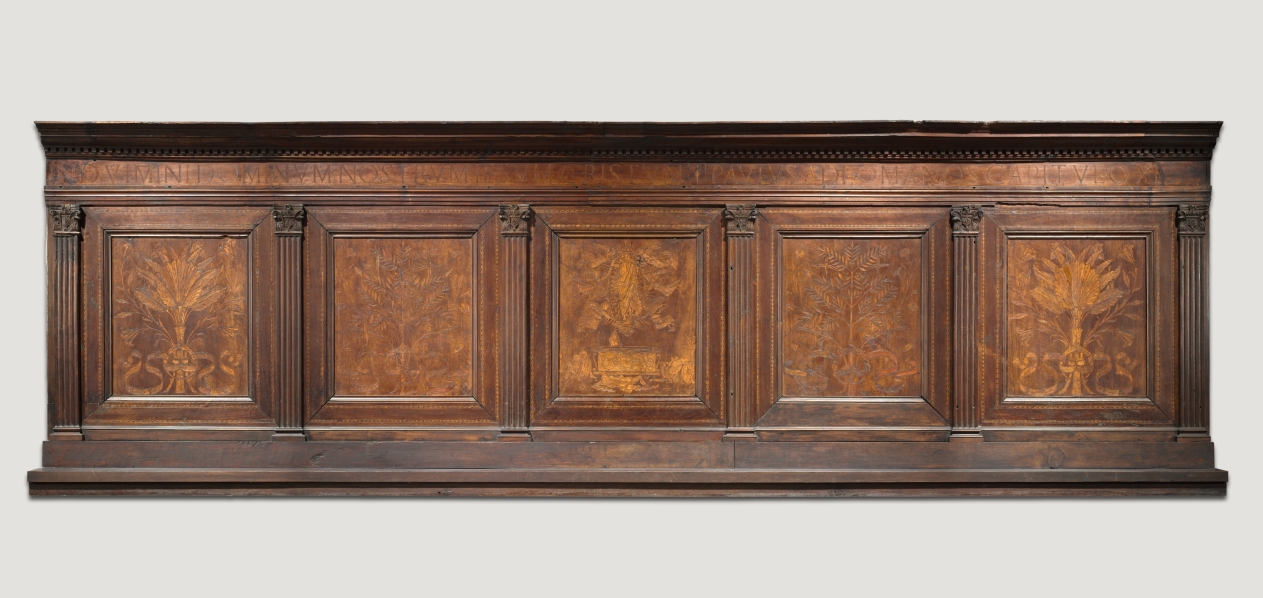
The imagery on the inset panels is the result of a technique known as intarsia, the skilled inlaying of woods of different colors to create a type of mosaic, popular during the 15th and 16th centuries in Italy for the decoration of paneling and furniture for studies, small rooms, and church sacristies. This large set of five intarsia panels comes from an unknown Florentine church. In its original setting the panels rested upon a row of similarly decorated cupboards (a sacristy armoire) which were used for the storage of liturgical vestments and books. This panel would have therefore been seen at eye level. The central panel depicts the Resurrection of Christ. The two outside panels depict the emblem of Lorenzo de Medici-three plumes encircled by a jeweled ring above a scrolling ribbon containing the Latin word SEMPER (Always). Lorenzo de Medici (1449-92) was the ruler of Florence when this sacristy armoire was constructed and was the likely patron. It seems to be the work of Giuliano da Maiano, an architect and intarsia-maker also responsible for the intarsia in the sacristy of Florence Cathedral.
The authoritative record is held by Cleveland Museum of Art. LinkedCulture surfaces this object and its connections; it does not alter institutional metadata.
Get printable QR codesHide QR codes
Open QR codes for this object page and the museum record. They stay collapsed until needed.
Provenance & credit
As published by the source institution. Coverage varies — not every institution's open-data feed includes ownership history.
- Credit line
- Gift of the John Huntington Art and Polytechnic Trust
- Provenance
- ?-1915: (Sangiorgi Galerie, Rome through Henry W. Kent, sold to the Cleveland Museum of Art). | 1915-: The Cleveland Museum of Art, Cleveland, OH
Related across collections
Semantically similar works from Cleveland Museum of Art and other institutions.