Cleveland Museum of Art
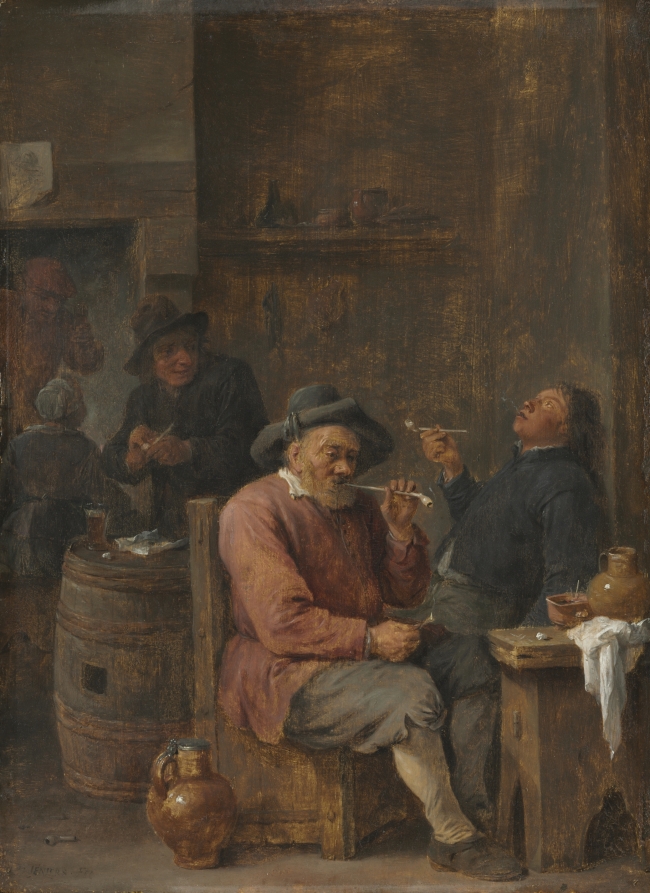
Peasants Smoking in an Inn
David TeniersLinkedCulture matchlcp-110718ec8366
- Date
- c. 1640
- Medium
- oil on wood
- Culture
- Flanders
- Department
- European Painting and Sculpture
- Institution
- Cleveland Museum of Art
- Object ID
- 95274
From the Cleveland Museum of Art record
David Teniers the Younger was a popular artist who specialized in small paintings of rustic Flemish life in the 1600s. In works such as Peasants Smoking in an Inn , an older man and a younger man in the foreground smoke tobacco. The younger man rests limply against the wall and his head lolls back, a gesture that symbolized that he had overindulged in smoke. Another standing man prepares his pipe and watches the younger man with amusement. Tobacco was a novelty in the 1600s, introduced from the Americas and East Indies with other new imports such as sugar cane and rice, and was believed to be a medicinal product. It was particularly recommended for people who lived in "waterish places" such as Antwerp, the capital of Flanders, where Teniers painted this scene. Although many medical practitioners believed tobacco to be a cure for numerous ailments, moral opponents to smoking criticized it as a danger to health and morals. The mixed reputation and widespread popularity of tobacco smoking thus made it a marketable and amusing subject for Flemish artists such as Teniers.
The authoritative record is held by Cleveland Museum of Art. LinkedCulture surfaces this object and its connections; it does not alter institutional metadata.
Get printable QR codesHide QR codes
Open QR codes for this object page and the museum record. They stay collapsed until needed.
Provenance & credit
As published by the source institution. Coverage varies — not every institution's open-data feed includes ownership history.
- Credit line
- Gift of Mr. and Mrs. J. H. Wade
- Provenance
- Louis de Bourbon-Conde, Comte de Clermont, 1709-1771 (Paris, France); | Bought by Jean-Baptiste-Pierre Lebrun, died 1813 (Paris, France), 1796 for Richard Codman (Boston, Massachusetts); | By inheritance to his son, John Codman, 1755-1803 (Boston, Massachusetts), 1803; | By inheritance to his son, Charles R. Codman, 1784-1852 (Boston, Massachusetts), 1852; | By inheritance to his son, Richard Codman (Boston, Massachusetts); | Sold through Boussod-Valadon to Mr. and Mrs. J. H. Wade (Gates Mills, Ohio), 1893 [as Interior Public House]; | By bequest to the Cleveland Museum of Art, 1916.
Related across collections
Semantically similar works from Cleveland Museum of Art and other institutions.