Cleveland Museum of Art
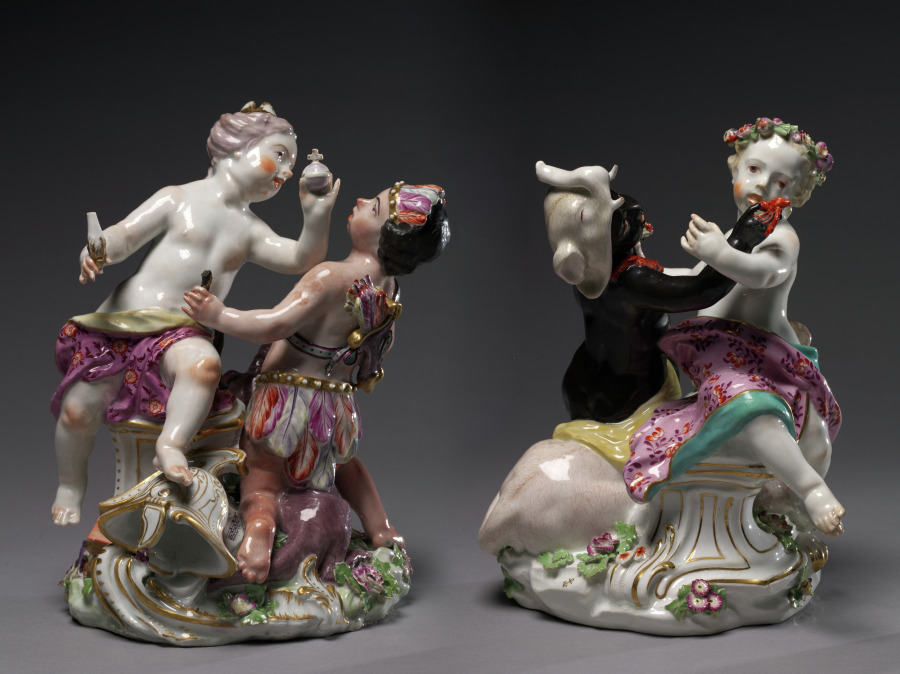
Pairs of Figures from the Four Continents
Chelsea Porcelain FactoryLinkedCulture matchlcp-4c2e63215576
- Date
- c. 1760
- Medium
- soft-paste porcelain
- Culture
- England, Chelsea, mid-18th century
- Department
- Decorative Art and Design
- Institution
- Cleveland Museum of Art
- Object ID
- 97957
From the Cleveland Museum of Art record
Often collected by wealthy British merchants who were beneficiaries of colonial expansion, figural groups were frequently part of elaborate table decorations meant to signify wealth and global prominence. In one pair, Europe is seen holding an orb and wearing a crown as queen of the world, suggesting Europe’s supremacy over the other continents. She is entangled with America, who is wearing feathers with a bow and arrow at her feet. Africa, who wears an elephant headdress and holds a scorpion in one hand, wrestles with Asia, who is surrounded by perfumes and native fruits. Today we recognize these depictions of America, Africa, and Asia as racial stereotypes, revealing a purely imagined understanding of other cultures and continents at the time. Figural representations of the four continents date back to the 1500s, but such imagery became even more popular in the 1700s as European empires expanded.
The authoritative record is held by Cleveland Museum of Art. LinkedCulture surfaces this object and its connections; it does not alter institutional metadata.
Get printable QR codesHide QR codes
Open QR codes for this object page and the museum record. They stay collapsed until needed.
Provenance & credit
As published by the source institution. Coverage varies — not every institution's open-data feed includes ownership history.
- Credit line
- Bequest of Mary Warden Harkness
- Provenance
- ?-1916: Mary Warden Harkness [1864-1916], New York, NY, bequest to the Cleveland Museum of Art | 1917-: The Cleveland Museum of Art, Cleveland, OH
Part of LinkedCulture topics
 18th Century European Porcelain Figures
These objects are decorative figural ceramics produced across Europe (Germany, England, France) during the 18th century, predominantly featuring musicians and social scenes rendered in porcelain and faience.
76 objects from 4 institutions
 18th Century Porcelain Figurines
These objects are decorative ceramic figures and figure groups made from soft-paste or hard-paste porcelain during the 18th century, produced by major European porcelain factories including Meissen, Sèvres, Derby, Chelse
413 objects from 4 institutions
Related across collections
Semantically similar works from Cleveland Museum of Art and other institutions.