Cleveland Museum of Art
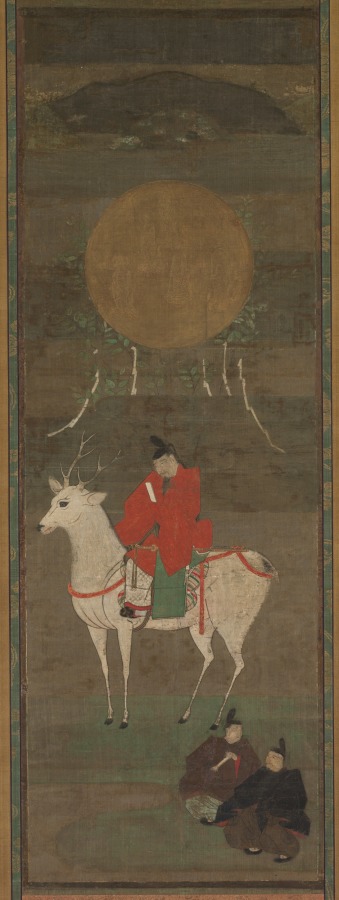
Departure from Kashima
- Date
- 1336–92
- Medium
- hanging scroll; ink and color on silk
- Culture
- Japan, Nanbokuchō period (1336–92)
- Department
- Japanese Art
- Institution
- Cleveland Museum of Art
- Object ID
- 98252
From the Cleveland Museum of Art record
The kami Takemikazuchi from Kashima (in present-day Ibaraki Prefecture) departs on a white deer for Mount Mikasa in Nara, where he takes up residence. The five Kasuga kami are presented within a golden circle supported by the branches of a sakaki tree, from which trail five white paper streamers—indicating the purity and sacredness of the five shrine halls of the complex—as well as blossoming wisteria vines, a symbol of the Fujiwara family. The two figures walking along near the stag’s back legs are Nakatomi no Tokifū and his younger brother Hidetsura, who have followed Takemikazuchi and become priests of Kasuga Taisha.
The authoritative record is held by Cleveland Museum of Art. LinkedCulture surfaces this object and its connections; it does not alter institutional metadata.
Get printable QR codesHide QR codes
Open QR codes for this object page and the museum record. They stay collapsed until needed.
Provenance & credit
As published by the source institution. Coverage varies — not every institution's open-data feed includes ownership history.
- Credit line
- The Worcester R. Warner Collection
- Provenance
- ?–1917: Purchased with funds from Worcester R. Warner [1846–1929] and Cornelia Blakemore Warner [1858–1947] by Langdon Warner [1881–1955], as agent of the Cleveland Museum of Art | 1917–: The Cleveland Museum of Art, Cleveland, OH
Related across collections
Semantically similar works from Cleveland Museum of Art and other institutions.