Getty Museum
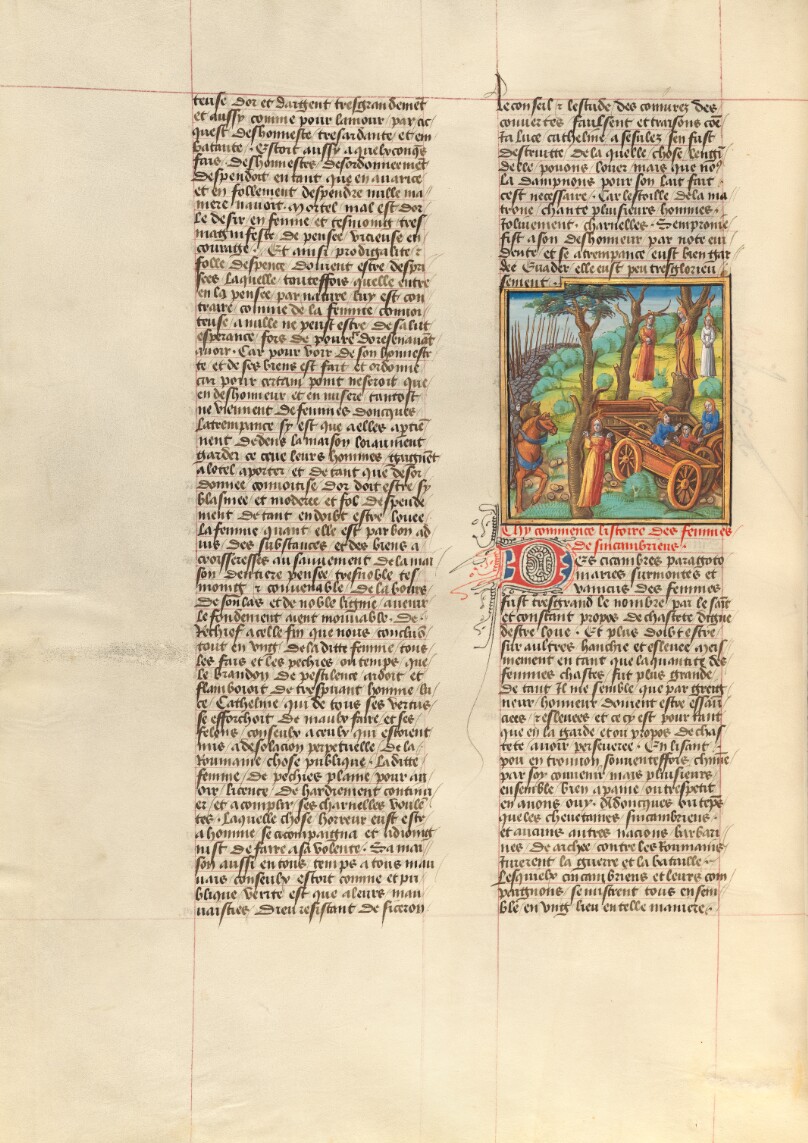
The Cambrian Women Dying by Suicide
- Date
- about 1450–1475, illumination added about 1515–1520
- Medium
- Tempera colors, gold, and ink
- Culture
- French
- Department
- Manuscripts
- Institution
- Getty Museum
- Object ID
- 004be2e6-16b2-4a46-8143-8167645b7f38
From the Getty Museum record
According to a legend catalogued by Boccaccio in Concerning Famous and Noble Women, a baggage train became the final battleground in the war between the Cimbrians (a Germanic people) and the Romans. Their men having been defeated, the remaining Cimbrian women created a stockade out of the carts and prepared to use swords, sticks, and rocks as weapons. Upon realizing that they could not hope to defeat the immense Roman army (indeed, in the image a series of helmets extends endlessly into the background) and after failing to establish a peace treaty, the women decided to end their lives and those of their children to preserve their freedom. Their pitiful bodies hang from the trees in the forest that was the location of their last stand. Though described as an episode from Antiquity, the artist of this image has decided to contemporize the clothing and setting, making it more engaging for the sixteenth-century viewer.
The authoritative record is held by Getty Museum. LinkedCulture surfaces this object and its connections; it does not alter institutional metadata.
Get printable QR codesHide QR codes
Open QR codes for this object page and the museum record. They stay collapsed until needed.
Related across collections
Semantically similar works from Getty Museum and other institutions.