Getty Museum
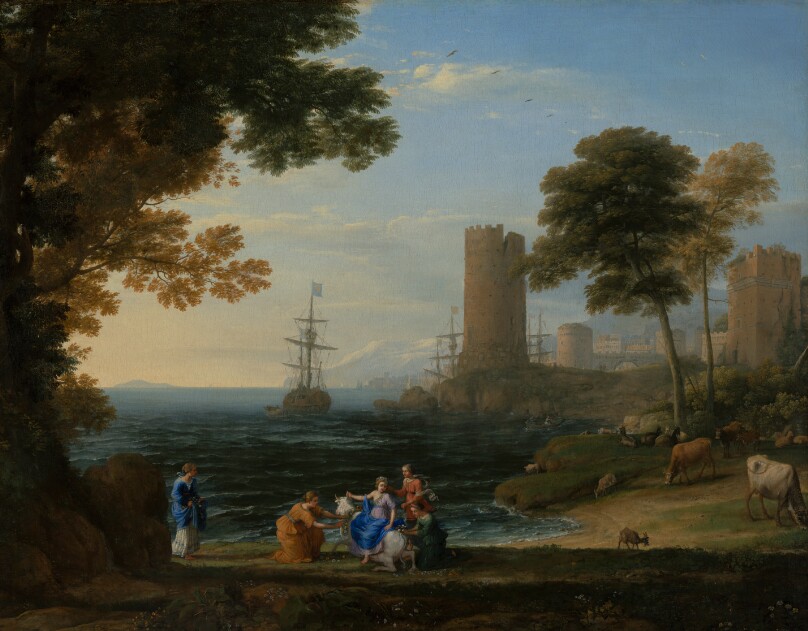
Coast View with the Abduction of Europa
Creator
Claude Lorrain (Claude Gellée)French Artist · 1604–1682
All works by this person →> Claude Lorrain knew the real world by heart, down to its minute details. He used it as a means of expressing the harmonious universe of his soul. > > --Johann Wolfgang von Goethe A peasant's son, Claude Gellée became known as Claude Lorrain, named after the duchy in which he was born. He had difficulty writing French and Italian and could barely count, but he could explain light's effects like a
More on Getty ULAN- Date
- about 1645
- Medium
- Oil on canvas
- Culture
- French
- Department
- Paintings
- Institution
- Getty Museum
- Object ID
- 01e5106c-a924-4e6e-8c90-6115f4a6a26d
What the image shows
A pastoral scene featuring a group of people near a riverbank with a ship in the distance and medieval towers in the background.
Generated by LinkedCulture from the photograph alone, without the museum’s catalogue text (Qwen/Qwen2.5-VL-7B-Instruct), and not yet reviewed by a person. It describes the picture, not the object’s history, and it is not part of the museum’s record.
From the Getty Museum record
The maiden Europa rests atop a white bull, unaware it is the god Jupiter in disguise. According to the tale in Ovid's *Metamorphoses*, soon the animal will abduct her across the waves. Until then, she and her attendants festoon the seemingly innocent beast with flowers, while her blue drapery flutters in the breeze. In the upper right corner, a hazy poetic light illuminates her home city of Tyre, further evoking an idyllic antique world. Claude Lorrain is known for painting complicated images that achieve a tranquil balance. This scene appears bucolic, but his composition and details also hint of impending danger. Beyond the field of delicate flowers, for example, a craggy tower looms. The women fail to notice that the bull is poised in anticipation, already straightening one of his legs for flight. Whitecaps gather behind them on the darkening sea, the backdrop to Europa's fate. Even in his day, Claude was known for developing a style called the Ideal Landscape, in which nature on the canvas surpasses the real thing in its beauty, harmony, and refinement. Here he balances formal elements, like the upright trees, ship, and towers, against the open expanse of sea and sky. Offshore, he juxtaposes the huge galleon and all its impeccable detail in the rigging and carved decoration, with Europa still on land. The maritime theme also had a deeper resonance for Claude's contemporaries, as in art criticism, the abduction of Europa was compared to a ship leaving shore. French by birth, and working in Rome, Claude often went into the countryside to do studies of nature. One of his hallmarks is the use of a unifying light, which gives this work a kind of gentle glow. The romance is punctuated by long shadows coming in from the left, distinctive of his favorite afternoon light, which help frame the drama at center stage.
The authoritative record is held by Getty Museum. LinkedCulture surfaces this object and its connections; it does not alter institutional metadata.
Get printable QR codesHide QR codes
Open QR codes for this object page and the museum record. They stay collapsed until needed.
Related across collections
Semantically similar works from Getty Museum and other institutions.