Getty Museum
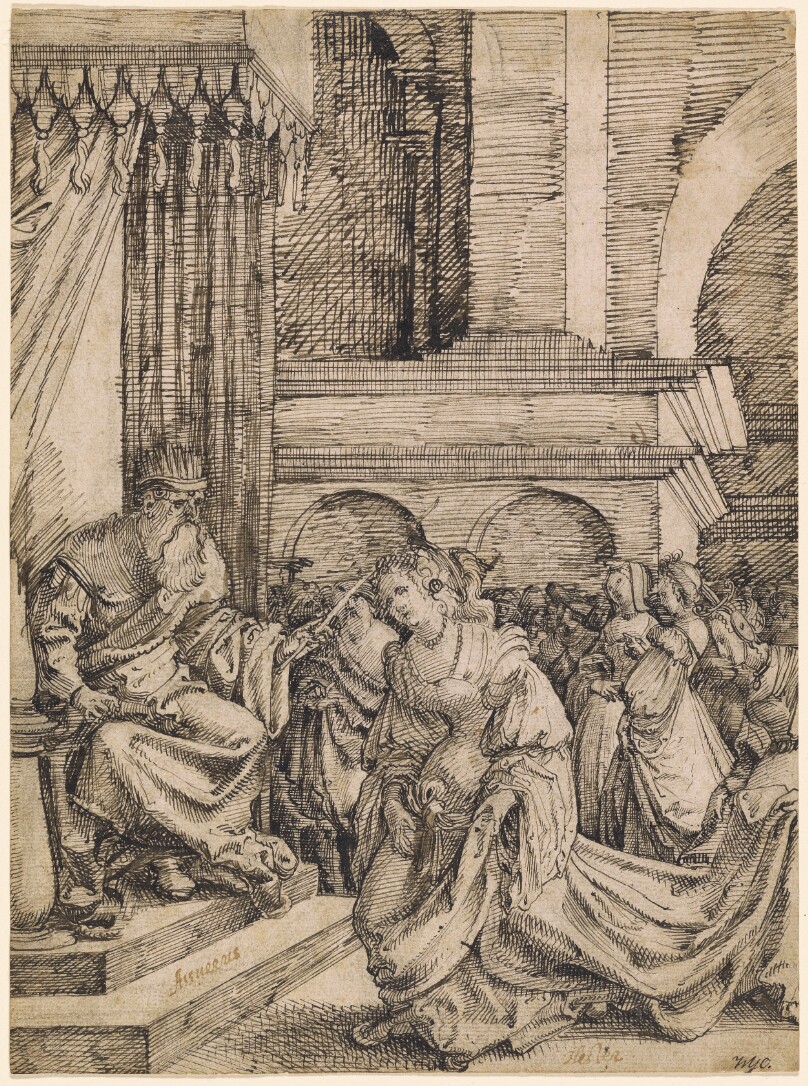
Esther Before Ahasuerus (recto); Slight Sketch of an Ornamental Vase (verso)
Creator
Frans Crabbe van EspleghemFlemish Artist · 1480–1552
All works by this person →Frans Crabbe van Espleghem, one of the leading artists in Mechelen, the capital of the southern Netherlands, began his career painting altarpieces. After Albrecht Dürer's visit to the Netherlands in 1521, Crabbe began exploring the medium of printmaking. He combined Italianate figure types with a concern for atmosphere and depth in landscape and a focus on ordinary daily life and humble people, bo
More on Getty ULAN- Date
- about 1525
- Medium
- Pen and dark brown ink, with touches of gray-brown wash, over black chalk, incised for transfer (recto); black chalk (verso)
- Culture
- Flemish
- Department
- Drawings
- Institution
- Getty Museum
- Object ID
- 029b15b6-febd-470b-8bbf-486711ad9f17
From the Getty Museum record
Esther approaches her husband King Ahasuerus, desperate to tell him of a plot to massacre the Jews. As Ahasuerus touches her with his golden scepter as a sign of his good favor, Esther faints with relief. Behind Esther, a crowd of courtiers, compressed into the dark background, watches in open-mouthed amazement at her daring. Frans Crabbe van Espleghem used complex patterns of hatching to create the various architectural and human forms. Busy lines of cross-hatching capture the shifting folds in Esther's dress. One of the first Netherlandish artists to experiment with the technique of etching on copper, Crabbe incised this fully worked preparatory drawing for transfer to a copper plate; the drawing corresponds almost exactly in scale to the finished etching.
The authoritative record is held by Getty Museum. LinkedCulture surfaces this object and its connections; it does not alter institutional metadata.
Get printable QR codesHide QR codes
Open QR codes for this object page and the museum record. They stay collapsed until needed.
Related across collections
Semantically similar works from Getty Museum and other institutions.