Getty Museum
The Holy Family
Creator
Giulio Romano (Giulio Pippi)Italian Artist · 1499–1546
All works by this person →Giulio Romano was so famous in the century after his death that he is the only "modern" artist mentioned by Shakespeare in a play. A Roman native, by about 1515 he was working for Raphael in the Vatican, eventually becoming the master's most trusted aide. Raphael's late works indicate the increasing torsion and tension that Mannerist artists like Giulio would bring to full flower, ideas that Giuli
More on Getty ULAN- Date
- about 1518–1520
- Medium
- Oil (possibly mixed with tempera) on panel
- Culture
- Italian
- Department
- Paintings
- Institution
- Getty Museum
- Object ID
- 0342428e-f24b-43ab-b0e5-209987580982
What the image shows
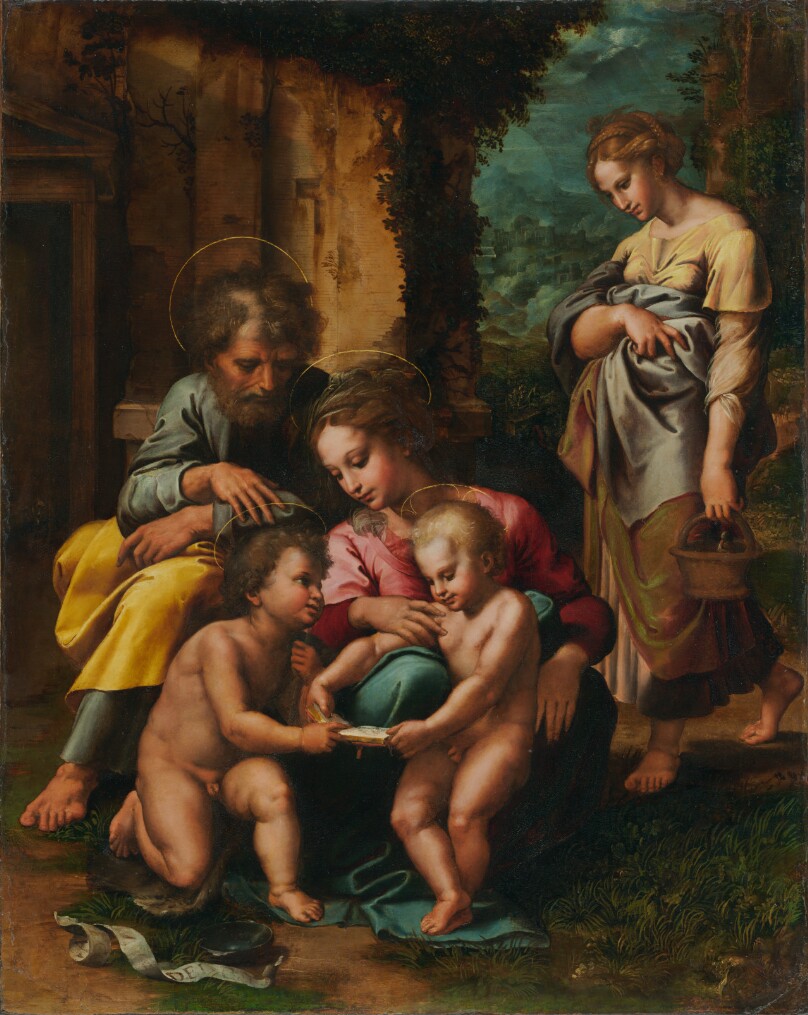
A religious painting depicting the Holy Family with two young children.
Generated by LinkedCulture from the photograph alone, without the museum’s catalogue text (Qwen/Qwen2.5-VL-7B-Instruct), and not yet reviewed by a person. It describes the picture, not the object’s history, and it is not part of the museum’s record.
From the Getty Museum record
Giulio Romano set Christ and John the Baptist's first meeting on the day of the traditional Jewish purification ceremony, forty days after John the Baptist's birthday. The meaning of this enigmatic painting is unclear, and it has been known by several titles. At right a woman carries a basket with two turtledoves, the required offering of the poor. After the purification ceremony, at which the priest recognized Christ's destiny, Mary, Joseph, and Jesus visited her cousin Elizabeth and John the Baptist, Elizabeth's son. Precociously, Jesus opens a book, showing that his birth signaled the debut of a new era. The scroll, one of the Baptist's attributes, reads *Ecce Agnus Dei* (Behold the lamb of God). As Raphael's most important protégé, Giulio adapted Raphael's late style in the darkly evocative landscape and these tightly interlocked figures and idealized female faces. Features typical of Giulio's work include the metallic palette, muscular figures with heavy features, and lively details such as the dog dashing out the doorway at left and the *all'antica* landscape at right.
The authoritative record is held by Getty Museum. LinkedCulture surfaces this object and its connections; it does not alter institutional metadata.
Get printable QR codesHide QR codes
Open QR codes for this object page and the museum record. They stay collapsed until needed.
Related across collections
Semantically similar works from Getty Museum and other institutions.