Getty Museum
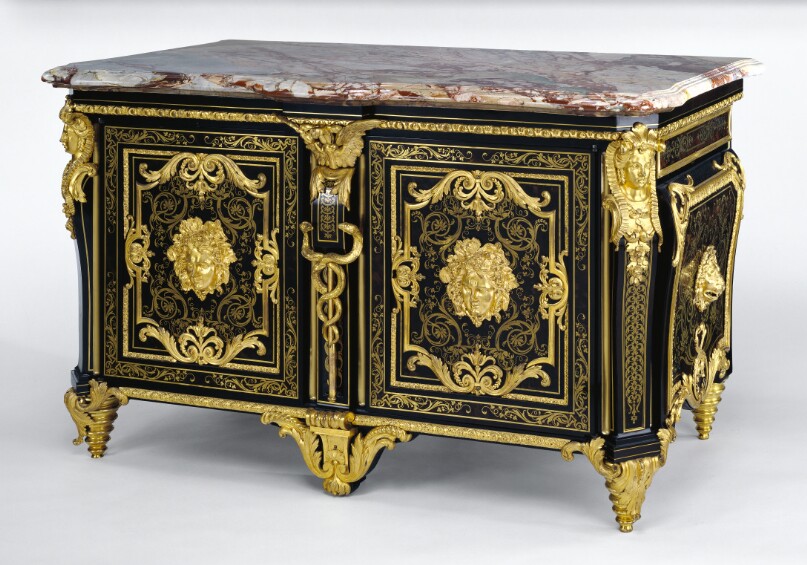
Cabinet (Cabinet des Médailles)
Creator
André-Charles BoulleFrench Artist · 1642–1732
All works by this person →Christened by his contemporaries as "the most skillful artisan in Paris," André-Charles Boulle's name is synonymous with the practice of veneering furniture with marquetry of tortoiseshell, pewter, and brass. Although he did not invent the technique, Boulle was its greatest practitioner and lent his name to its common name: boulle work. Boulle also specialized in floral marquetry in both stained a
More on Getty ULAN- Date
- about 1710–1715
- Medium
- Oak and fir veneered with ebony, amaranth, kingwood, brass, and tortoise shell, gilt-bronze mounts; sarrancolin des Pyrénées marble top
- Culture
- French
- Department
- Decorative Arts
- Institution
- Getty Museum
- Object ID
- 03da429f-7b3b-4aa0-8a2a-9536c8cc9861
From the Getty Museum record
This cabinet originally contained twenty-four shallow drawers intended to hold coins or medals. One of a pair, its companion in the Hermitage Museum, Saint Petersburg, Russia, still retains its original interior fittings. At some point, the cabinet's entire interior was removed and converted into a cigar humidor. An inventory taken in 1767 on the death of the son of Robert de Cotte, *Premier Architecte* to Louis XIV, king of France, describes two medal cabinets made by André-Charles Boulle, probably referring to this pair. Apart from the masks in the center of the doors and the lions' heads on the sides, which are later replacements, all the mounts are unique to the pair. The gilt-bronze caduceus with entwined snakes, normally the symbol for medicine, is here associated with Mercury, the god of commerce--an appropriate reference for the storage-place of coins.
The authoritative record is held by Getty Museum. LinkedCulture surfaces this object and its connections; it does not alter institutional metadata.
Get printable QR codesHide QR codes
Open QR codes for this object page and the museum record. They stay collapsed until needed.
Related across collections
Semantically similar works from Getty Museum and other institutions.